
Why Does Fashion Keep Returning to Surrealism?
A major new Dalí exhibition has opened in Milan just as fashion is once again making ordinary clothes behave strangely

There is something wonderfully appropriate about opening an exhibition dedicated to Salvador Dalí and fashion in the middle of Milan Fashion Week. Walk through the Spring 2027 collections and fashion is already behaving a little strangely. At MM6, shirts become dresses, sweaters migrate to the hips and trousers reconsider whether they would rather be skirts. At Prada, familiar pieces are assembled into outfits that seem deliberately resistant to conventional harmony. At Jil Sander, Simone Bellotti is introducing creases, distortions and awkward proportions into a house synonymous with precision. None of these collections is explicitly Surrealist, nor should every strange garment be traced back to Dalí. But together they reveal an instinct fashion has returned to repeatedly for almost a century: when the familiar becomes too familiar, make it behave incorrectly.
That makes Dalí and Fashion, opening today at Milan's Palazzo Reale, particularly timely. The exhibition brings together more than 200 works and archival materials, including paintings, drawings, photographs, garments, films, jewellery and objects, to examine the artist's relationship with clothing, the body, identity and desire. Historic material from houses including Schiaparelli, Chanel, Dior and Rabanne appears alongside Dalí's work for magazines and fashion imagery, while Gala's wardrobe is also brought into the story. It is an enormous survey of a relationship that helped establish some of the most enduring intersections between fashion and Surrealism.
The obvious story would be about Dalí's influence on fashion. It would also be an unnecessarily familiar one. His collaborations with Elsa Schiaparelli have become part of fashion mythology: the lobster dress, the shoe hat, the transformation of everyday objects and body parts into things that could be worn. His relationships with fashion extended considerably further, encompassing designers, photographers, magazines, advertising and his own carefully constructed public image. The exhibition itself positions clothing not as a peripheral curiosity in Dalí's practice but as part of the symbolic vocabulary running through it, with shoes, dresses, jackets, gloves and jewellery repeatedly appearing in his work.
The more interesting question is why fashion has never really stopped returning to the idea.
FASHION GETS BORED WITH REALITY

Fashion and Surrealism make unusually compatible partners because both are interested in transformation. Clothes already perform a peculiar function: they take the human body and allow it to become something else. Taller, narrower, broader, richer, stranger, sexier, more severe, more anonymous or more visible. Fashion doesn't simply cover the body; it continually proposes alternative versions of it.
Surrealism gives that instinct permission to become irrational. A shoe can become a hat. Lips can become furniture. A lobster can crawl across an evening dress. An eye can become jewellery. A torso can become a bottle. A garment can imitate nakedness while covering the body beneath it. The familiar object remains recognizable, but its expected relationship to the world has been interrupted.
That interruption is crucial. Surrealism does not necessarily depend on creating something nobody has ever seen before. Often its power comes from taking something everybody understands and putting it somewhere it doesn't belong. The resulting object sits in an uncomfortable space between recognition and confusion. We know what we're looking at. We just don't understand why it is behaving that way.
Fashion loves exactly that tension. It explains why Surrealist ideas have remained so fertile long after Surrealism itself ceased to be a contemporary artistic movement. Designers do not need to reproduce Dalí to use its logic. Trompe-l'œil can make a flat surface appear dimensional. A bag can resemble an ordinary household object. Jewellery can reproduce anatomy. A heel can appear structurally impossible. A garment can contain openings where openings shouldn't exist. Proportion can transform a recognizable piece of clothing into something faintly absurd. The clothes remain clothes. They simply stop obeying.
WHEN BEAUTY ISN'T ENOUGH

Fashion tends to return particularly enthusiastically to strangeness when straightforward beauty begins to feel insufficient. A perfectly beautiful dress can inspire desire, but it rarely requires explanation. We understand it immediately. Surrealism inserts a question mark.
That question mark has enormous value in an industry built around producing new images of fundamentally familiar objects. There are only so many essential categories in a wardrobe. Designers will continue making jackets, skirts, dresses, shirts, trousers, bags and shoes because people continue needing things to put on their bodies. The challenge is finding ways to make those objects newly visible.
Making them strange is one answer. Schiaparelli understood this exceptionally well. Clothing could still be elegant while containing something absurd. The Surrealist intervention did not necessarily destroy beauty; it prevented beauty from becoming passive. An evening dress could remain glamorous while carrying a lobster across its surface. A meticulously dressed woman could put an inverted shoe on her head. Refinement and ridiculousness could occupy the same object.
That contradiction remains remarkably contemporary because fashion still struggles with the same problem: how do you make something desirable without making it predictable?
Daniel Roseberry's contemporary Schiaparelli has demonstrated how potent the answer remains. Anatomical jewellery, exaggerated breasts, ears, eyes, toes and impossible bodily forms have helped return the house's Surrealist vocabulary to popular culture, but the larger inheritance extends far beyond one maison. Surrealism has become part of fashion's toolkit whenever reality needs disrupting.
It can be witty. It can be unsettling. It can be sexual. It can be grotesque. Sometimes it is simply fun. But it almost always asks the viewer to look twice.
MILAN IS MAKING THE FAMILIAR STRANGE AGAIN

This is where the timing of the Palazzo Reale exhibition becomes unexpectedly useful. The Spring 2027 collections currently unfolding around it are not staging a Surrealist revival in any literal sense. There are no grounds for declaring another Dalí moment simply because fashion has become peculiar again. What they do share, however, is an increasing interest in disrupting the expected behaviour of familiar clothes.
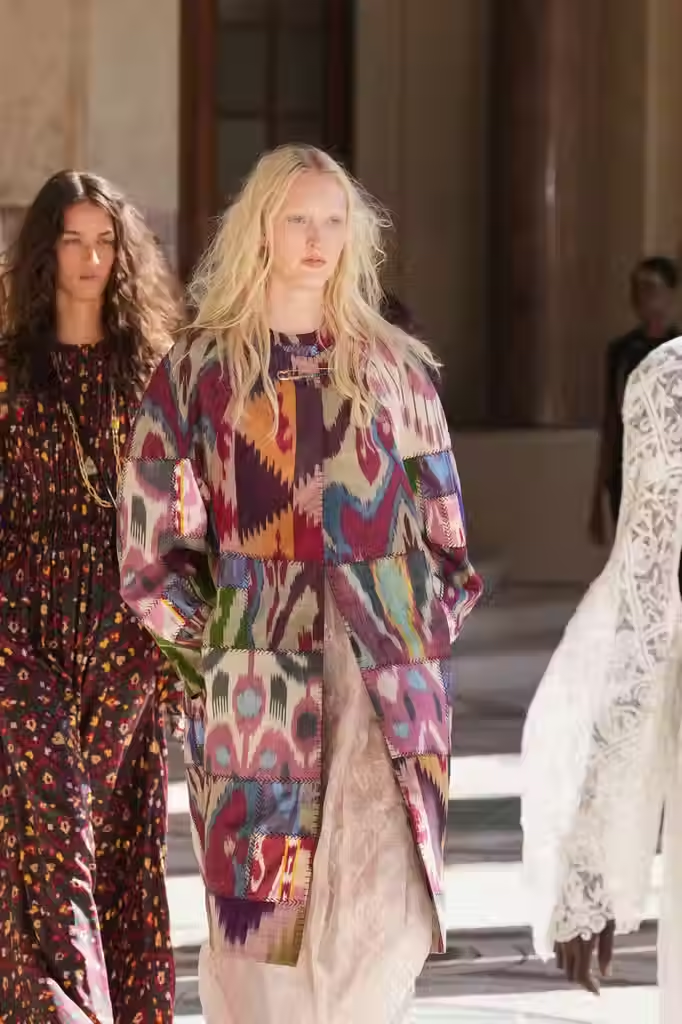
MM6 offered perhaps the clearest example. Its collection treated the wardrobe almost as though nobody had explained how clothing was supposed to work. A shirt could fold into a dress while remaining visibly a shirt. Trousers could become a miniskirt. A sweater moved from torso to hips and acquired volume through the studio's jokingly named “hip-paulette.” The approach was described in terms reminiscent of childhood experimentation: trying things everywhere without worrying about where they were supposed to go.
The result wasn't Surrealism in the historic sense, but the mechanism feels familiar. Recognition comes first. Displacement follows. Prada played another version of the game. Its Spring collection was built entirely around skirts, 63 looks exploring a garment Miuccia Prada has long treated almost as a personal uniform. But conventional femininity was repeatedly disturbed: tiny bras met substantial skirts, technical materials collided with ribbons and bows, crystal embroidery appeared on utilitarian Velcro, and polished elements were placed beside things that seemed determined not to agree with them.
At Jil Sander, the intervention is quieter still. Bellotti has acknowledged that the perfection historically associated with the house is no longer enough in a world where minimalism has become mainstream. His response is to make precision slightly wrong: crease it, twist it, enlarge something beyond expectation, allow control to slip just enough that the eye notices it again.
Three very different collections arrive at a related proposition. Familiarity becomes interesting again when something interferes with it.
THE INTERNET MADE EVERYTHING TOO LEGIBLE

There may be a particularly good reason for fashion to crave that interference now. The digital fashion ecosystem rewards immediate recognition. Algorithms need categories. Search needs keywords. Social platforms teach aesthetics through repetition until enormously complicated histories of clothing are compressed into easily identifiable visual packages: quiet luxury, coquette, old money, clean girl, mob wife, balletcore. The point is not that any of these aesthetics is inherently bad. It is that they become most communicable when everything agrees.
The loafer confirms the trouser. The bow confirms the dress. The bag confirms the social identity. The interior confirms the wardrobe. Eventually an aesthetic becomes so coherent that you understand the image before you've really looked at it.
Surrealism is almost constitutionally opposed to that kind of legibility. Its pleasure comes from the thing that refuses its category. The eye where the button should be. The shoe on the head. The body represented where the body is hidden. The object that has escaped its intended function. It interrupts recognition rather than accelerating it.
That feels unexpectedly valuable in an era when fashion imagery can be consumed at extraordinary speed and increasingly generated by machines capable of producing visual perfection on demand. The perfectly coherent image has never been easier to make. Perhaps that is precisely why the irrational detail has regained some of its power. The strange thing makes us stop scrolling.
DALÍ'S REAL FASHION LEGACY

Perhaps Dalí's most enduring contribution to fashion, then, is not a catalogue of motifs to be periodically rediscovered. It is permission. Permission for fashion to be intellectually unserious and culturally serious at the same time. Permission for glamour to contain a joke. Permission for beauty to become disturbing without ceasing to be beautiful. Permission for an object to remain luxurious while also being ridiculous. Permission, above all, to treat the rules governing bodies and clothes as material for experimentation rather than fixed truths.
That is why simply cataloguing Dalí's influence risks underselling what happened. Influence implies a line running from one creator to another: Dalí did this, therefore fashion later did that. The relationship is much messier and more interesting. Surrealism gave fashion a method it could keep using long after its original protagonists disappeared.
The new exhibition at Palazzo Reale demonstrates just how thoroughly Dalí understood fashion's possibilities. He did not approach clothes merely as products onto which art could be applied. Clothing, accessories, bodies, magazines, photography and self-presentation all belonged to the same imaginative world. Fashion could transform identity precisely because it existed somewhere between reality and performance.
Nearly a century later, the industry is still working inside that territory. The lobster does not need to return. Neither does the shoe hat. Fashion doesn't need another literal reproduction of Surrealism's greatest hits. What it keeps needing is the instinct underneath them.
Take something we recognize. Move it somewhere it shouldn't be. Change its scale. Distort its function. Make the beautiful thing slightly uncomfortable, the serious thing slightly ridiculous or the ordinary thing impossible. Then make us look again. Dalí didn't simply collaborate with fashion. He helped teach it how useful it could be to misbehave.


Comments