
A century of couture goes under the hammer
An upcoming Paris auction places extraordinary creations by Chanel, Madeleine Vionnet, Dior and Balenciaga under the hammer

Imagine being offered a choice between a contemporary designer handbag and an evening dress created by Gabrielle Chanel nearly a century ago. One represents the current luxury market, complete with its increasingly ambitious prices. The other is a surviving piece of fashion history, created during a period when designers were fundamentally reconsidering how women should dress. Depending on the handbag, the difference in price might be surprisingly small.
On October 21, Bonhams will stage 1910–2010, 100 Years of Haute Couture in Paris, bringing together garments spanning a century of changing tastes, silhouettes and attitudes toward the female body. Among the highlights is a Chanel evening gown from 1928, made from Nile-green tulle with silver sequins and estimated at €6,000 to €8,000. A Madeleine Vionnet evening dress from 1924, fashioned in almond-green moiré with a silver ribbon and an extravagant bow at the back, carries an estimate of €4,000 to €6,000.

These are not insignificant sums, but they are fascinating when placed beside the contemporary luxury market. A modern designer bag can easily cost several thousand euros, while certain ready-to-wear pieces command prices comparable to historic couture. Yet the Chanel and Vionnet garments represent something that cannot simply be reproduced next season: surviving examples of the techniques and ideas that helped transform twentieth-century fashion.
When a dress changed the way women moved
The historical significance of the auction extends far beyond the names on the labels. The early twentieth century witnessed a profound reconsideration of how clothing should relate to the female body, and designers such as Chanel and Vionnet were instrumental in that transformation.
Chanel's approach challenged the elaborate restrictions of earlier fashionable dress, introducing a vocabulary of relative simplicity, ease and movement. Vionnet approached the same question through construction, famously developing the bias cut to allow fabric to follow the body's natural contours. Her garments achieved their extraordinary fluidity not through excessive decoration, but through a sophisticated understanding of how material behaves when cut and assembled.
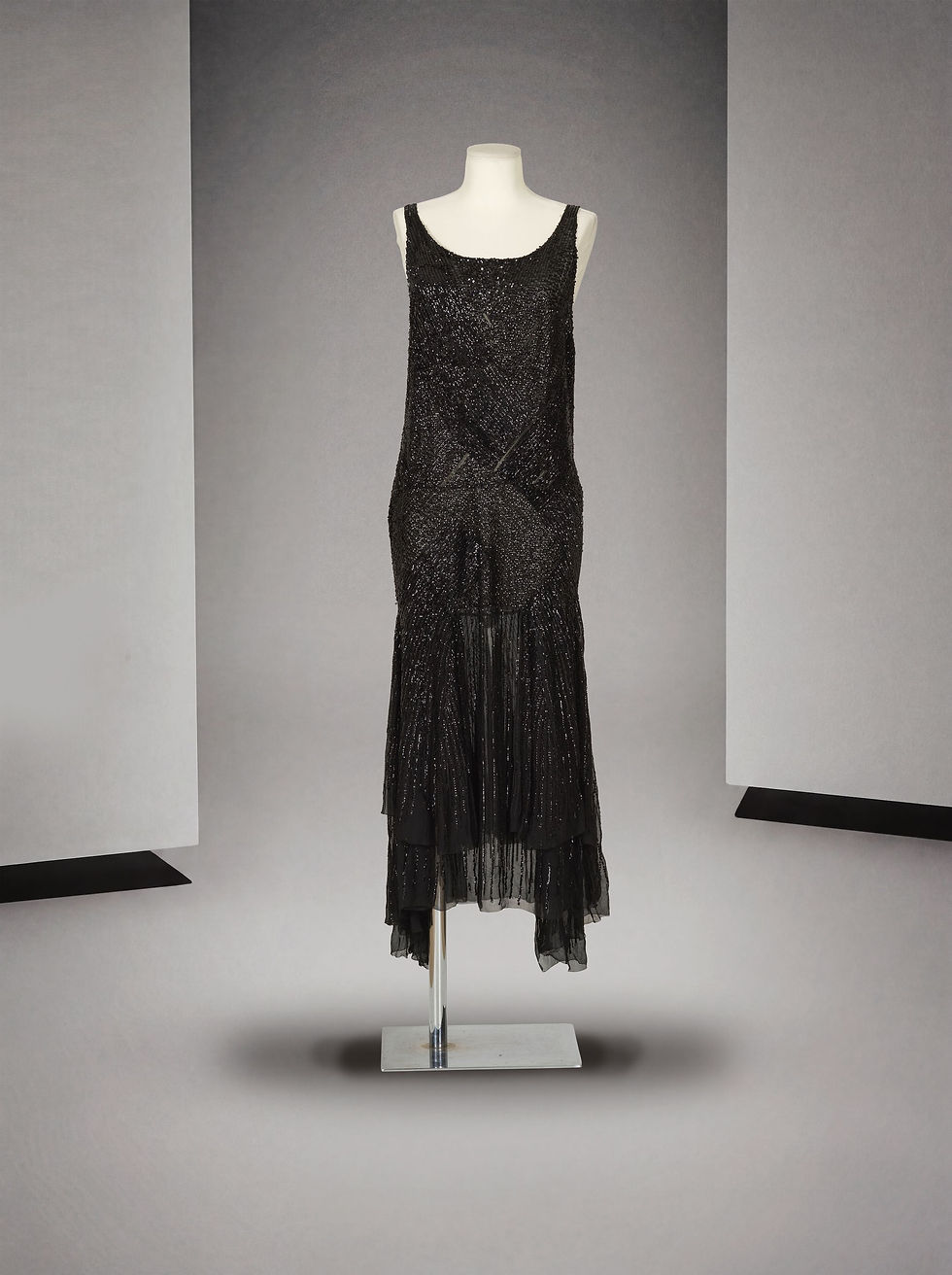
The auction's 1924 Vionnet dress offers a tangible connection to that experimentation. Its delicate straps, straight neckline and sculptural bow belong to a period when eveningwear was becoming less dependent on rigid structure and more responsive to movement. Nearly a century later, the technical intelligence behind such garments remains relevant to designers working today.
Later creations by Dior, Givenchy, Balenciaga and Mugler illustrate how dramatically the relationship between fashion and the body continued to evolve. Dior's postwar silhouettes restored volume and architectural shaping, while Balenciaga explored the possibilities of constructing space around the figure. Mugler, decades later, approached the body through heightened theatricality, exaggeration and an almost futuristic sense of glamour.
Seen together, these garments become more than examples of changing fashion. They reveal how designers have repeatedly reconsidered the ideal silhouette, sometimes liberating the body from established conventions and sometimes constructing entirely new ones around it.
Why isn't historic couture always more expensive?
The prices raise an intriguing question about what the luxury market actually values. A garment's historical importance does not necessarily translate into an extraordinary auction result, just as a contemporary item's retail price does not guarantee that it will retain its value.
The vintage couture market operates according to its own complicated considerations. Condition, provenance, rarity, documentation and the desirability of a particular designer or period all influence what collectors are willing to pay. A fragile evening dress that requires specialist conservation and cannot realistically be worn presents a very different proposition from a contemporary handbag designed for everyday use.

There is also the distinction between an auction estimate and a final selling price. Bonhams' figures are guides rather than guarantees, and competition between collectors could push individual pieces substantially higher. Buyer's premiums and other charges further complicate any direct comparison with retail prices.
Nevertheless, the estimates reveal something interesting about contemporary luxury. Modern pricing reflects far more than the physical garment itself, incorporating brand positioning, marketing, distribution and the commercial power of desirability. Historic couture, by contrast, must compete for attention in a collecting market where cultural significance is only one component of value.
A century-old Chanel dress may possess extraordinary historical importance without commanding the price of a newly released luxury object. The apparent contradiction tells us as much about the economics of desire as it does about the garments themselves.
Fashion history is becoming something people can own
The growing visibility of archival fashion auctions reflects a wider fascination with collecting clothing as cultural material. Important garments are increasingly discussed not simply as vintage pieces to be worn, but as objects that document creative achievement, changing social values and the evolution of design.

There is something particularly compelling about encountering fashion history through the garments themselves. A museum exhibition can explain why a designer mattered, but an original dress reveals the physical evidence: the placement of a seam, the weight of the fabric, the complexity of an apparently effortless silhouette. These details are difficult to appreciate through photographs alone.
Of course, private ownership introduces its own complications. Important garments may disappear into collections where they are rarely seen, while preservation requires specialist knowledge and considerable resources. The relationship between collecting, scholarship and public access is not always straightforward.

Still, the Bonhams sale offers an unusually accessible way to reconsider fashion's history through its surviving objects. The garments represent different generations of designers responding to the bodies, tastes and expectations of their time, each leaving behind evidence of what they believed clothing could become.
On October 21, collectors will decide what those pieces are worth in monetary terms. Their historical value, however, has already been established through the influence they continue to exert on fashion.
And perhaps that is the most intriguing part of the auction. A century of couture is about to receive a series of price tags, but the ideas stitched into those garments have proved considerably more enduring than any estimate.


Comments