
Erdem's women are becoming part of fashion history
For two decades, Erdem Moralioglu has imagined wardrobes for women whose lives exist somewhere between history and fiction. Now, his first major retrospective in Doha turns the designer's own creative history into a museum narrative.

Erdem Moralioglu has spent much of his career dressing women he has never met. Historical figures, artists, performers and aristocrats have provided the starting points for elaborate fictional wardrobes, allowing the designer to imagine their private lives through clothing. Now, after twenty years of constructing stories around other people's histories, he is about to become the subject of one himself.
Opening on 27 October at M7 in Doha, ERDEM: About Time, About Her marks the twentieth anniversary of his London-based label. Curated by Olivier Gabet, director of the Department of Decorative Arts at the Louvre, the exhibition brings together more than 150 pieces, including garments, sketches and atelier materials, to explore the relationship between fashion, memory and historical storytelling.
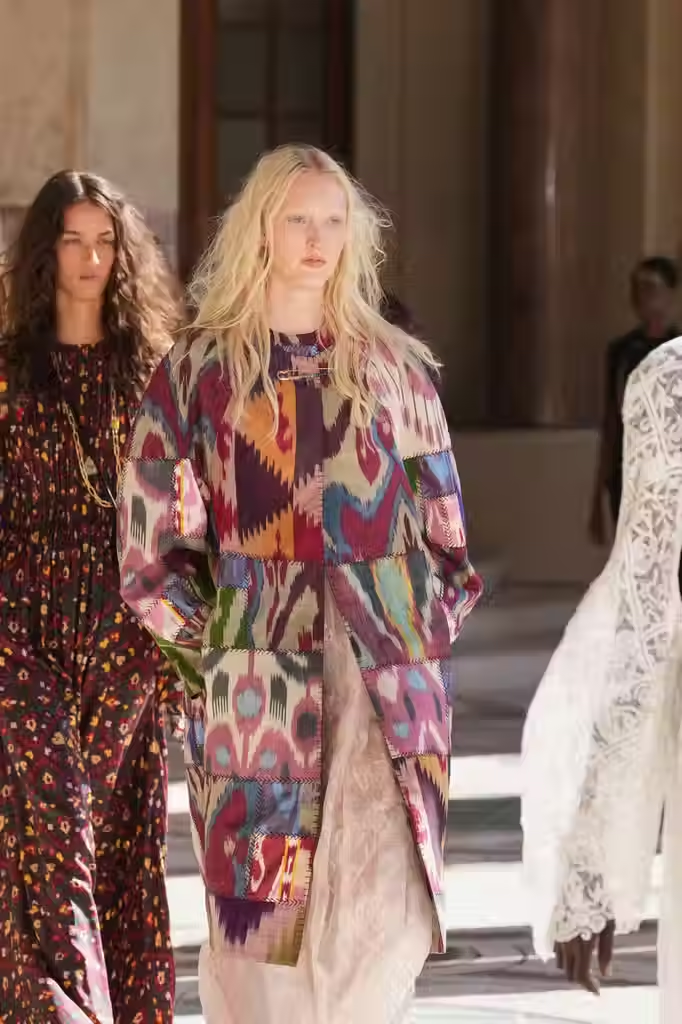
The premise is particularly appropriate for a designer whose collections often resemble beautifully researched historical novels. Erdem's women are rarely straightforward period references. Instead, fragments of their lives become the foundations for imagined wardrobes, with embroidery, silhouette and fabric suggesting personalities that history has not always fully recorded.
The women behind the clothes
Among the figures explored are opera singer Maria Callas, ballerina Margot Fonteyn, botanical artist Marianne North and the Duchess of Devonshire. Their lives span different periods and professions, yet each reflects Erdem's fascination with how women negotiate identity, visibility and social expectations.
His elaborate florals, intricate embroidery and occasionally eccentric proportions are frequently rooted in historical research, but they rarely attempt faithful reconstruction. History becomes material for invention, allowing the designer to explore the distance between a woman's public image and her imagined private world.

The exhibition unfolds across five thematic chapters, examining Erdem's creative process, recurring design signatures and the personalities who have shaped his imagination. His Autumn/Winter 2026 anniversary collection also features, connecting two decades of work with a creative practice that continues to evolve.
Rather than presenting a chronological procession of beautiful dresses, the retrospective promises to reveal how a recognizable fashion language develops through research, experimentation and recurring obsessions.
When fashion becomes history
One of the exhibition's most intriguing elements is the inclusion of paintings, sculptures and decorative objects from Doha's Museum of Islamic Art. Presented alongside Erdem's garments, these objects invite comparisons between fashion, craftsmanship and artistic traditions across different periods.
The pairing also raises an interesting question about how museums construct fashion history. On the runway, a garment belongs to a season and a contemporary creative conversation. Inside a museum, it becomes an object of historical interpretation, examined through its construction, references and relationship to other works.
For Erdem, that transition is especially fitting. He has spent years transforming historical fragments into contemporary clothing. Now, a curator is selecting fragments of his own career and arranging them into a narrative intended to explain his significance.
Museums do more than preserve history. Through the objects they select and the relationships they establish, they shape how creative legacies are understood. A retrospective can reveal connections that were less apparent when individual collections first appeared, but it can also make a career seem more orderly than the experimentation behind it.
That tension makes this exhibition particularly compelling. Erdem remains an active designer, and his creative history is still unfolding. The retrospective is therefore less a final assessment than an opportunity to examine the ideas that have sustained his work.
There is something wonderfully appropriate about a designer so fascinated by women's histories becoming the subject of historical interpretation himself. For twenty years, Moralioglu has used clothing to imagine the lives of others. In Doha, those same garments will tell the story of the person who created them.
ERDEM: About Time, About Her runs from 27 October to 26 December 2026 at M7, Msheireb Downtown Doha, Qatar.


Comments