
What People Wore to Valentino, and the Books They Thought Were Worth Bringing
Alessandro Michele gave Valentino's Spring/Summer 2027 guests an unusually revealing dress code: bring a book.
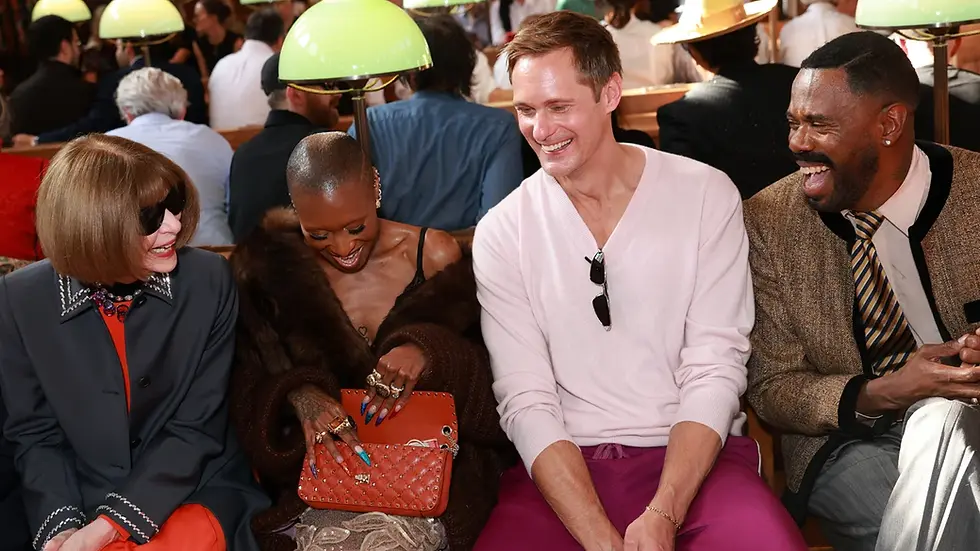
Fashion-week arrivals are normally an exercise in controlled revelation. The clothes tell us something, although usually something negotiated between a celebrity, stylist and fashion house. The bag has probably been selected. The jewelry certainly has. Even the apparently spontaneous sunglasses may have a reason for being there. At Valentino's Spring/Summer 2027 show in Paris, Alessandro Michele added an accessory that was considerably harder to style away: a book.
Guests arriving at the Bibliothèque Sainte-Geneviève were asked to bring a volume, either new or from their own collection, which would later be donated to local libraries. It was part of Michele's Antibiblioteca, a collection inspired by Nassim Nicholas Taleb's writing about Umberto Eco's enormous personal library and the idea that unread books represent everything we have yet to know. The resulting arrivals became something far more entertaining than another best-dressed front row. Everyone still came dressed for Valentino, but they also had to decide which book they were willing to be photographed holding.
And really, what could be a better personality test?
Cynthia Erivo brought Giovanni's Room
Cynthia Erivo arrived with James Baldwin's Giovanni's Room, which is almost suspiciously good as a fashion-show book choice. Baldwin's 1956 novel deals with desire, identity, shame and the consequences of attempting to live according to the person society expects you to be rather than the person you actually are.

Erivo, meanwhile, arrived looking entirely capable of holding her own against Michele's maximalist Valentino. There is something satisfying about the combination because neither the clothes nor the book is particularly interested in disappearing quietly into the background. If fashion-week guests were going to be forced to reveal their bookshelves, Erivo understood the assignment.
Colman Domingo brought Julia Child
Colman Domingo's choice was considerably more domestic and perhaps even more charming: Julia Child's Mastering the Art of French Cooking. He carried it while wearing a tweed jacket and tie, producing the unexpected impression of an extremely elegant man who might leave the Valentino show and make everyone dinner.

It is also exactly the kind of book that makes this exercise more interesting than asking celebrities for their favourite novel. A cookbook is meant to become stained, annotated, returned to and actually used. At a show built around the value of books and garments that may remain untouched, Domingo arrived carrying something designed for the opposite purpose.
Alexander Skarsgård brought Icelandic stories

Alexander Skarsgård went appropriately Nordic, carrying a Swedish-language collection of Icelandic tales. There is admittedly something almost too aesthetically perfect about Skarsgård arriving at a nineteenth-century Parisian library carrying Nordic literature while dressed for Alessandro Michele's Valentino. Had he produced a minimalist Scandinavian crime novel, the character might have become unbearable. Icelandic tales, however, give us sagas, mythology, strange landscapes and centuries of storytelling, which feels considerably more appropriate beside Michele's particular appetite for history and fantasy.
It also made the book feel less like a prop. Bringing something in your own language to an international fashion event is a small but rather lovely declaration that not everything needs to be translated for the room.
Clairo brought Clarice Lispector
Clairo arrived in a red pleated Valentino look carrying Covert Joy by Clarice Lispector, bringing Brazilian literary modernism into Michele's Parisian library.
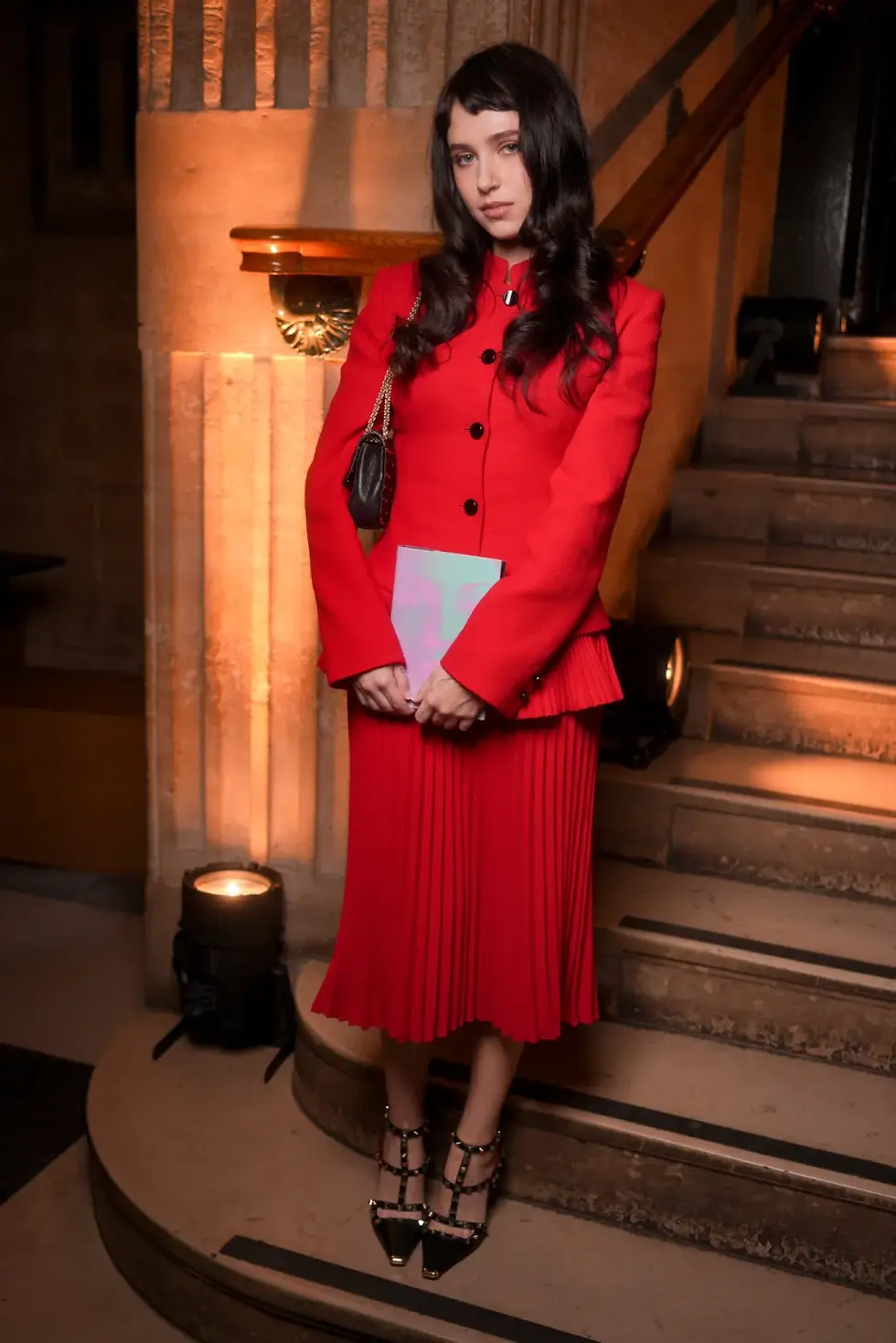
Lispector has become something of a literary cult figure well beyond Brazil, particularly among younger readers attracted to writing that is introspective, strange and difficult to reduce to a neat plot summary. Paired with Clairo, whose own image often trades in a similarly understated kind of cool, the choice felt less like someone selecting the most impressive book on the shelf and more like an actual glimpse of taste.
That is precisely what made the Valentino arrivals work. A handbag can tell us what someone has access to. A book can occasionally tell us what they are curious about.
Zoey Deutch brought extinction to Fashion Week
Zoey Deutch selected Elizabeth Kolbert's Pulitzer Prize-winning The Sixth Extinction, which examines the accelerating disappearance of species and humanity's role in the current extinction crisis.
It is not exactly breezy front-row reading, and that makes it one of the more interesting choices. Fashion Week is an environment built around novelty, consumption and the constant production of another season, while Kolbert's book confronts the environmental consequences of human activity on an almost incomprehensibly larger scale. The juxtaposition is uncomfortable enough to be useful.
Whether Deutch intended that particular fashion-industry commentary is another matter. The book still brought it into the room.
Jeff Satur brought manifestation
Thai musician and actor Jeff Satur chose Roxie Nafousi's Manifest: 7 Steps to Living Your Best Life, or a related edition in the Manifest series, bringing a considerably more contemporary form of self-development into a library otherwise heavy with literary credibility.
And why not? The temptation with an invitation like Valentino's is to suddenly become the most intellectually formidable version of yourself. Everyone owns at least one book that would make them look more impressive in a photograph than the thing they actually enjoyed reading last week. A manifestation book is refreshingly unembarrassed about being useful to the person carrying it.
The Valentino library was better for having Julia Child and self-help sitting alongside Baldwin and Lispector. Real bookshelves tend to be inconsistent because real people are inconsistent.
The best accessory at Valentino wasn't for sale

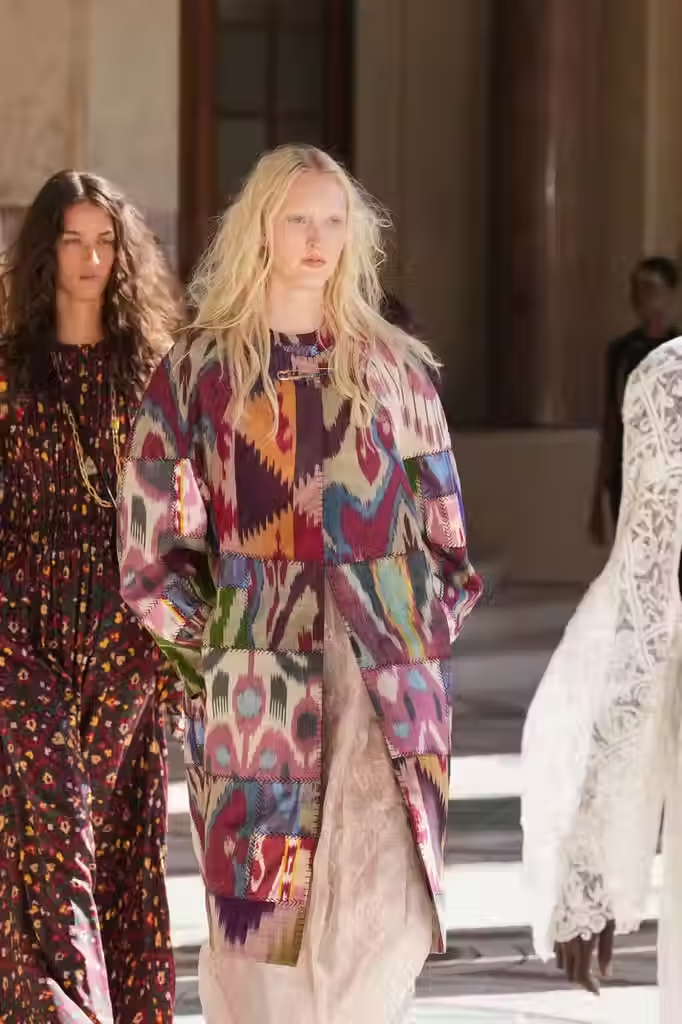
There were plenty of actual accessories competing for attention. Michele's collection delivered enormous baroque gold necklaces, oversized pearls, studded cross-body bags, embellished clutches, tinted eyewear and enough decorative hardware to ensure nobody could accuse Valentino of entering a quiet-luxury phase.
Yet outside the show, the books became more interesting precisely because they resisted the usual hierarchy of fashion-week objects. A celebrity holding a Valentino bag tells us that Valentino would like us to look at a Valentino bag. A celebrity arriving with a battered favourite book, a cookbook or something translated from another language introduces information that hasn't been completely determined by the fashion system.
That made the arrivals unusually human. Clothing has always been used to communicate identity, but fashion has become extraordinarily good at controlling that communication. The right stylist can construct a reference, the right archive pull can manufacture fashion credibility and the right accessory can arrive with a contract attached. Asking someone to choose a book introduces a different kind of self-curation, certainly, but one with much stranger possibilities.
Michele's Antibiblioteca was ultimately concerned with possibility itself: the unread books that contain things we don't yet know and the unworn clothes that represent versions of ourselves we may never become. The guests inadvertently extended that idea before the first model appeared.
For once, looking at the Valentino front row made you wonder not only where someone got the coat, but what they might be reading on the flight home.


Comments