
Venice After Dark: Cartier’s Cinema Club
At the 2026 Venice Film Festival, Cartier transformed an evening at the Gritti Palace into the beginning of something larger

Venice understands entrances. There are few cities where arriving somewhere can become an event before the event itself has begun. A water taxi cuts across the lagoon, slows as it enters the Grand Canal and pulls alongside a hotel pontoon. Evening clothes emerge onto the water's edge. Across the canal, the white domes of Santa Maria della Salute rise above the darkening water. By September, this ritual has become inseparable from the Venice International Film Festival, where cinema may provide the reason everyone has come, but fashion helps create the mythology around it.
On the evening of 4 September 2026, the destination was the Gritti Palace. Cartier was celebrating its fifth year as a main sponsor of the Venice International Film Festival and introducing the Cartier Cinema Club, a new international programme dedicated to the collective nature of filmmaking and the artists and artisans working both in front of and behind the camera.
The guest list naturally moved between those worlds. Amal Clooney, Emma Corrin, Kate Mara, Orlando Bloom, Karlie Kloss and Taylor Russell were among those gathered at the hotel, alongside filmmakers, actors, festival figures and Cartier clients. There were cocktails on the terrace, dinner by candlelight and, eventually, dancing on the rooftop.
Yet the evening offered something more interesting than another collection of famous people in expensive clothes. It demonstrated why Venice has become such extraordinary fashion territory.
When Cinema Dresses for Venice
The Venice Film Festival occupies an unusual position within the fashion calendar. It is not organised around clothes, yet every September it generates some of the most closely watched fashion images of the year. Part of that comes from timing. Venice arrives immediately before the major Spring Summer fashion weeks begin, just as the industry is accelerating towards New York, London, Milan and Paris. But the setting changes the character of what people wear.
Cannes has the monumental staircase of the Palais and the relentless theatre of the Croisette. The Met Gala has a theme and a staircase engineered for spectacle. Fashion week exists within the professional machinery of fashion itself. Venice offers water. Actors arrive at premieres by boat. Daytime photographs happen against weathered palazzi and wooden jetties. Sunglasses, silk, tailoring and evening gowns are framed by canals rather than step and repeats. Formal dressing feels slightly less contained because the city is constantly intruding into the image.
At the Cartier Cinema Club, that relationship between clothes and place was particularly visible.
Amal Clooney arrived in a scarlet draped chiffon gown, its fluidity amplified by a Cartier necklace combining chrysoprase, coral and diamonds. The effect relied heavily on colour. Red against green stones, gold, diamonds and the fading Venetian light produced the kind of unapologetically glamorous composition that can feel almost excessive elsewhere and entirely appropriate here.
Emma Corrin moved in another direction, wearing a slender black camisole dress by Haider Ackermann for Tom Ford with diamond Panthère de Cartier jewellery. Where Clooney's look embraced the romantic possibilities of Venice, Corrin's was reduced and controlled, allowing the jewellery and the body's movement to do much of the work. Kate Mara arrived in a high neck Gucci dress covered in crystals.
Three women, three different approaches to evening dressing, and none required the elaborate styling interventions that often dominate fashion specific events. Venice supplied enough atmosphere already.
The Jewellery Changes Everything

There is a particular logic to Cartier hosting an evening like this during a film festival. High jewellery and cinema share a dependence on light, movement and proximity. A necklace photographed motionless against a neutral background can be examined as an object. Put it on someone moving through a room, beneath changing light, and its character becomes entirely different.
Cinema understood that relationship early. Jewellery has helped construct screen characters for generations, from diamonds used as shorthand for wealth and desire to pieces that become inseparable from the actresses wearing them. Film can turn an object into a cultural image, while jewellery can communicate something about a character before dialogue ever begins.
Cartier's relationship with cinema therefore extends beyond dressing actresses for premieres. The maison has been an official partner of the Venice International Film Festival since 2021, building programmes around the people and crafts involved in filmmaking rather than limiting its presence to red carpet visibility. In 2025, Cartier sponsored all of the masterclasses on the festival's official programme for the first time, while its Art and Craft of Cinema conversations examined collaborative practices behind the camera.
The Cinema Club expands that relationship in 2026. Cartier describes the new programme as international in scope, with individual events intended to celebrate the creative communities responsible for bringing cinema to life. The emphasis on collaboration is significant. A finished film may ultimately be associated with a director and its stars, but cinema is constructed by costume designers, cinematographers, editors, production designers, composers, craftspeople and countless others whose work shapes what appears on screen. A jewellery house built around ateliers and specialist métiers has an obvious point of connection.
Dinner at the Gritti
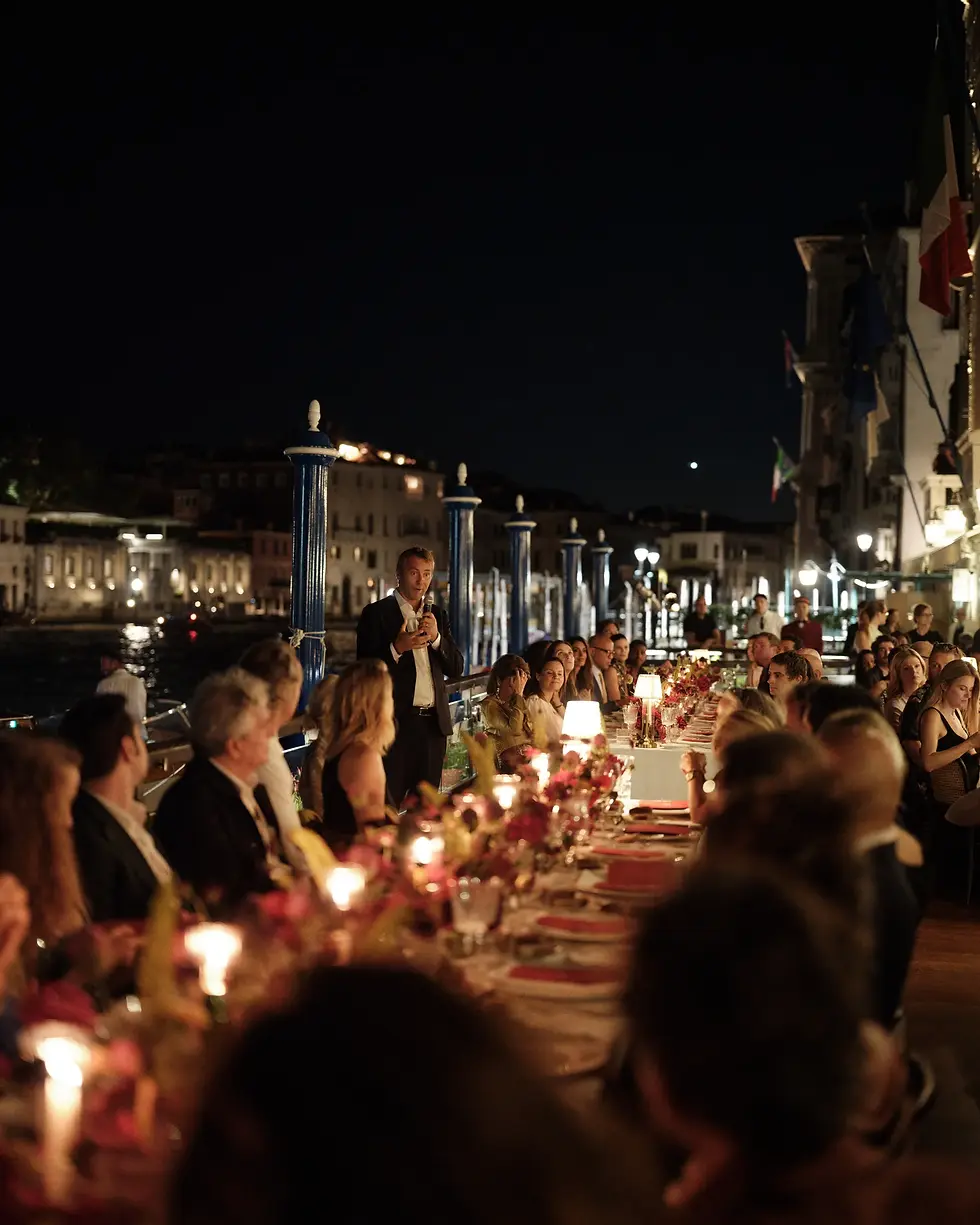
The Gritti Palace provided an almost impossibly Venetian setting for the Cinema Club's formal launch.
After drinks, guests moved into a candlelit dinner on the terrace overlooking the Grand Canal. Amberjack and lobster were followed by pineapple carpaccio, while the tables were filled with anthuriums and pompon dahlias in Cartier red. Across the water stood Santa Maria della Salute, its reflection appearing in the canal as daylight disappeared.
The hotel itself contributes considerably to the atmosphere. Housed in a former noble residence on the Grand Canal, the Gritti has long been embedded in the particular mythology of glamorous Venice, where hotels function as much more than places to sleep during the festival. Their terraces, bars, jetties and private rooms become extensions of the festival's social architecture.
The Cartier gathering consequently felt closer to a salon than a conventional branded party.
Many of those present had attended the maison's Venice events in previous years, giving the dinner something of the atmosphere of an annual reunion. Arnaud Carrez, Cartier's senior vice president and chief marketing officer, addressed guests during the evening, reaffirming the house's support for the festival and formally introducing the Cinema Club concept.
Then dinner ended and everyone moved upwards. On the rooftop terrace, cocktails replaced place settings and a DJ began playing vinyl. Venice remained visible beyond the party, now almost entirely dark except for the illuminated architecture reflected across the water. The transformation was subtle but important. What had begun as a formal jewellery and cinema dinner loosened into something social. And fashion often becomes more interesting once people stop posing.
Amal in Red

There is a reason Amal Clooney became the visual centre of much of the coverage from the evening.
Her relationship with Venice carries its own history. She and George Clooney married in the city in 2014, and during the Cartier evening she spoke about returning to the places associated with their wedding. In 2026, the trip acquired another layer of significance as George Clooney received the Golden Lion for Lifetime Achievement during the festival.
But the fashion worked independently of the personal narrative. Scarlet chiffon in Venice is hardly an exercise in understatement, nor should it be. The gown's draping and softness allowed the colour to dominate without requiring complicated construction, while the Cartier necklace introduced a much less predictable combination of green chrysoprase, coral and diamonds.
That unexpected colour relationship is what elevated the look. High jewellery styling can easily become overly respectful. A neutral gown is selected so that the necklace remains the unquestioned focal point. Everything coordinates. Nothing interferes. Clooney's combination did something more interesting. The jewellery and dress competed slightly. Red met green. Coral entered the conversation. Diamonds provided light rather than becoming the entire story. The result felt dressed rather than displayed.
The New Language of Festival Style

Corrin offered the counterargument. The black Tom Ford dress was almost spare by comparison, a slinky camisole silhouette accompanied by a diamond Panthère de Cartier earring and bracelet. It represented another increasingly visible direction in red carpet dressing, where the fashion statement comes from precision rather than volume.
Neither approach is inherently more modern. What is changing is the expectation that event dressing must conform to a single formula. A gown can be enormous or barely constructed. Jewellery can coordinate or deliberately interrupt. Archival fashion can coexist with a current runway look. Tailoring can compete with couture. A major appearance can be meticulously orchestrated while still appearing personal.
Film festivals have become particularly fertile ground for this experimentation because actors are dressing repeatedly over several days. There is an arrival look, a photocall, a premiere, dinner, press appearances and parties. Style becomes cumulative.
Venice magnifies that process. The water taxi photograph has become almost as recognisable as the red carpet itself. What someone wears stepping onto a boat at midday may travel globally before the premiere gown appears hours later. Fashion unfolds as a sequence rather than a single ceremonial look.
For brands, that creates an enormous cultural stage.
Fashion Wants Cinema
The presence of Cartier at Venice also belongs to a much broader relationship developing between luxury fashion and the film industry. Major houses increasingly operate around cinema rather than merely dressing its stars. They fund cultural programmes, support festivals, host filmmaker conversations, develop awards, commission films and build relationships with actors extending far beyond traditional endorsement.
The attraction is understandable. Fashion sells objects, but the most powerful luxury brands sell worlds around those objects. Cinema is one of the most effective machines ever created for world building.
A coat can become unforgettable because of the character who wore it. A handbag can acquire cultural meaning through a scene. A piece of jewellery can become attached to an actress, a decade or an entire cinematic fantasy.
Cartier's Venice strategy has increasingly moved towards that deeper territory. Alongside the Cinema Club, its festival involvement includes masterclasses and the Cartier Glory to the Filmmaker Award, which recognises a figure considered to have made a particularly original contribution to contemporary cinema.
In 2026, the surrounding programme extended beyond the dinner. The Cinema Club began with an event connected to Werner Herzog's Bucking Fastard, bringing Herzog together with cast members Orlando Bloom, Kate Mara, Rooney Mara and Domhnall Gleeson ahead of the film's festival premiere.
The maison also planned a musical celebration of La La Land at Teatro La Fenice for the film's tenth anniversary, with composer Justin Hurwitz conducting music from the film in the city where it first premiered a decade earlier. Taken together, these projects begin to explain what the word club might mean. It is less a physical venue than a network around cinema.
Why Venice Still Matters

By the end of the evening at the Gritti Palace, the tables had emptied and the party had migrated to the roof. Below, the Grand Canal continued moving through the city. Santa Maria della Salute remained visible across the water. Actors who had spent the week being photographed on red carpets were drinking Negronis and talking to friends. Jewellery designed to be scrutinised under controlled lighting was now moving through a crowded terrace.
The scene captures something Venice continues to do exceptionally well. The festival allows glamour to feel slightly irrational again. There is inconvenience everywhere. Boats replace cars. Heat complicates evening clothes. Historic buildings resist the efficient choreography expected of contemporary events. Water determines how and when people arrive. The city is too beautiful to disappear politely into the background.
And fashion benefits from that friction. Cartier could stage a dinner almost anywhere. Diamonds will sparkle in Paris, London or New York. A celebrity guest list will generate photographs regardless of geography. Venice adds narrative. The water taxi becomes an entrance. A palazzo becomes a set. The Grand Canal becomes lighting and scenery. An evening gown belongs temporarily to the city around it.
For the debut of the Cartier Cinema Club, that relationship between place, cinema, jewellery and style was the real story. The clothes mattered. The diamonds mattered. So did the films being discussed over dinner and the people who made them. But outside, Venice kept appearing in every frame. And perhaps that is why fashion returns each September.


Comments