
The Forgotten Trapeze Artist Behind Erdem's Spring 2027
A century before fashion began its contemporary conversations about gender fluidity, a Texan trapeze artist named Barbette was captivating Paris

There is a moment in Barbette's performance that fascinated Jean Cocteau. For most of the evening, the audience believed it was watching a beautiful woman fly above the stage, balancing across the high wire and performing acrobatics in feathers, jewels and an elaborate blonde wig. Then the performance ended. Backstage illusion became part of the spectacle, and Barbette removed the wig to reveal the masculine identity beneath the character the audience had been watching. The transformation was not incidental to the act. It was the act, and in Paris during the 1920s and 1930s, it made Barbette a sensation.
Born Vander Clyde in Texas, Barbette entered performance young and eventually joined an aerial act in which presenting as female became part of the role. By the time Barbette reached Europe, the act had evolved into something considerably more sophisticated than female impersonation for novelty's sake. The combination of extraordinary athletic ability, constructed femininity and the eventual revelation of the performer beneath it captivated the Parisian avant-garde. Cocteau became an admirer and wrote about Barbette; Man Ray photographed the performer in 1926, producing images in which a muscular torso, theatrical makeup, wig, costume and aerial harness occupy the same body without resolving neatly into masculine or feminine. One of those photographs remains in the collection of the Metropolitan Museum of Art today.
A century later, Erdem Moralioglu found Barbette.

The designer first began exploring the performer's story while developing Resort 2027 after encountering Cocteau's writing. What interested Moralioglu was not simply the visual drama of a 1920s aerialist, although Barbette offered plenty of that. It was the ambiguity within the photographs and the idea of a performer existing somewhere between identities rather than moving cleanly from one to another. Resort became an introduction to the subject; Spring 2027 expanded it into an entire wardrobe.
That distinction matters because the easiest possible interpretation would have been costume. Barbette provides almost irresistible fashion material: feathers, sparkling performance clothes, lingerie, theatrical makeup, the circus, Paris nightlife and the decadent glamour of the interwar years. Erdem could have recreated the performer and produced an extremely beautiful collection in the process. Instead, Spring 2027 became more interested in the tension underneath the feathers.

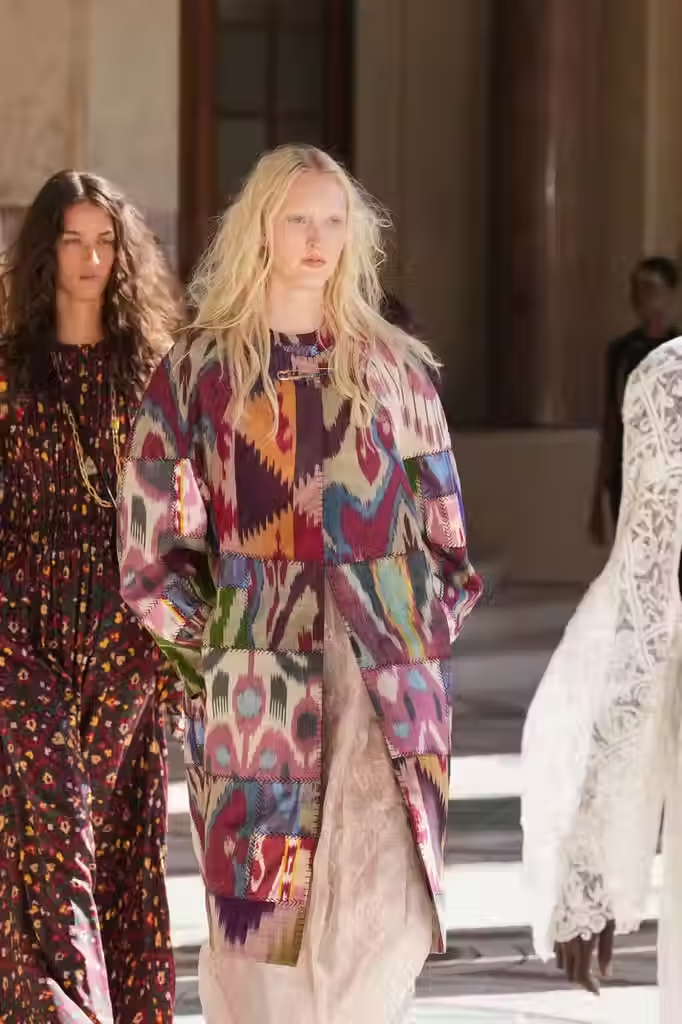
The runway moved constantly between the traditionally feminine and masculine. Sparkle-embroidered leotards, bras, briefs, lingerie-light dresses and ostrich feathers drew directly from Moralioglu's study of Man Ray's Barbette photographs. Against them came tailoring, crisp shirting, tweed coats and more traditionally masculine structures. Rather than separating those wardrobes, Erdem layered them together, allowing underwear to appear against tailoring and fragile surfaces to meet harder ones. The point was not that one side belonged to Barbette the performer and another to Vander Clyde the man. The interest was in the space where the distinction became less useful.
It produced a different kind of glamour for Erdem. Moralioglu has always been exceptionally comfortable with beauty. Flowers, lace, historical references, extraordinary fabrics and women pulled from the margins of cultural history have long populated his collections. His clothes can be unabashedly romantic without becoming naive about romance. Barbette gave him an especially useful subject because the beauty was constructed so deliberately. Femininity became something performed, exaggerated and assembled through clothes rather than something automatically attached to the body wearing them.

That idea feels remarkably contemporary for a performer whose fame peaked approximately a century ago. Discussions of gender expression can sometimes be presented as though fashion has only recently discovered that clothing can complicate the categories attached to the person wearing it. Barbette's career is a reminder that performers, artists and subcultures have been playing with those boundaries for generations. The terminology changes. The fascination does not.
Barbette's particular power also came from refusing an easy distinction between illusion and authenticity. The feminine figure onstage was not simply a disguise to be discarded so the audience could finally see the “real” performer underneath. Cocteau was fascinated by the transformation itself, while Man Ray's photographs deliberately preserved the ambiguity. A made-up face, muscular shoulders, feathers, harness and wig could all belong to the same image. The contradiction was not something that needed solving.

Erdem understood the usefulness of leaving it unresolved. That is why the strongest pieces in Spring 2027 were not necessarily those that looked most literally like circus costumes. A masculine jacket worn against something delicate could carry more of Barbette's story than a head-to-toe recreation ever could. Evening tailoring sat comfortably beside extravagant gowns. Jeans and day jackets appeared within the same collection as crystal embroidery and feathered performance references. Moralioglu has developed Erdem considerably beyond the floral evening dresses with which the label is still frequently associated, and Barbette gave him a narrative through which that broader wardrobe could make sense.
There is a commercial evolution happening underneath the historical storytelling too. Erdem is preparing to open a New York store next May, and Spring 2027 demonstrated how complete the world around the label has become. There were shirts, pajama suits, tailoring, denim, coats, bags and two voluminous Barbour collaborations alongside the elaborate eveningwear. Barbette may have supplied the narrative, but Moralioglu used it to show a customer considerably more than clothes for the grand entrance.

Still, it is the forgotten performer hovering above the collection who gives it its emotional pull. Fashion frequently resurrects historical women as muses, particularly women whose lives provide the requisite mixture of glamour, tragedy and extraordinary clothes. Barbette complicates that familiar formula. Here was a performer from small-town Texas who built an internationally celebrated identity through physical skill, theatrical transformation and a refusal, whether deliberate or simply inherent to the performance, to make masculinity and femininity behave as opposites.
It is easy to understand why Erdem became fascinated. Barbette also reminds us how selective cultural memory can be. The performer was famous enough to captivate Paris, to inspire Cocteau and to stand before Man Ray's camera, yet the name is hardly familiar to most people encountering Erdem's collection today. Fashion can occasionally be accused of treating history as an exceptionally beautiful mood board, stripping references of their lives until only the visual remains. Spring 2027 is more rewarding when approached in the opposite direction. The clothes provide a reason to discover the person.

That makes Barbette more than Erdem's seasonal muse. The collection becomes a bridge back to an artist whose work was already asking questions fashion continues to negotiate a hundred years later: how much of identity can be constructed through dress, what happens when clothing contradicts what we think we know about the body inside it, and why the space between categories can be considerably more interesting than either category alone.
Erdem found glamour there, but not the uncomplicated kind. Barbette's glamour depended on transformation, athleticism, illusion and ambiguity, on an audience believing one thing and then being forced to reconsider what it had just seen. Spring 2027 preserves something of that tension. Its feathers and crystals are beautiful, its gowns designed to make entrances, but underneath the decoration is a more interesting proposition about the person wearing them.
A century ago, Barbette stepped onto a trapeze and made an audience reconsider what it thought it was looking at. Erdem's Spring 2027 collection makes a compelling case for looking again.


Comments