
Madrid Has Had Enough of Beige
From Adolfo Domínguez's study of color to Palomo's birds of paradise, Spring 2027 is making a very persuasive case for turning the saturation back up

There is nothing inherently wrong with beige. Nor black, grey, cream, camel or any of the other dependable shades that have spent the past several years forming fashion’s exceptionally tasteful neutral wardrobe. But somewhere between quiet luxury, investment dressing and an endless supply of beautifully photographed oatmeal knitwear, color began to feel almost rebellious again.
Madrid appears more than willing to rebel.
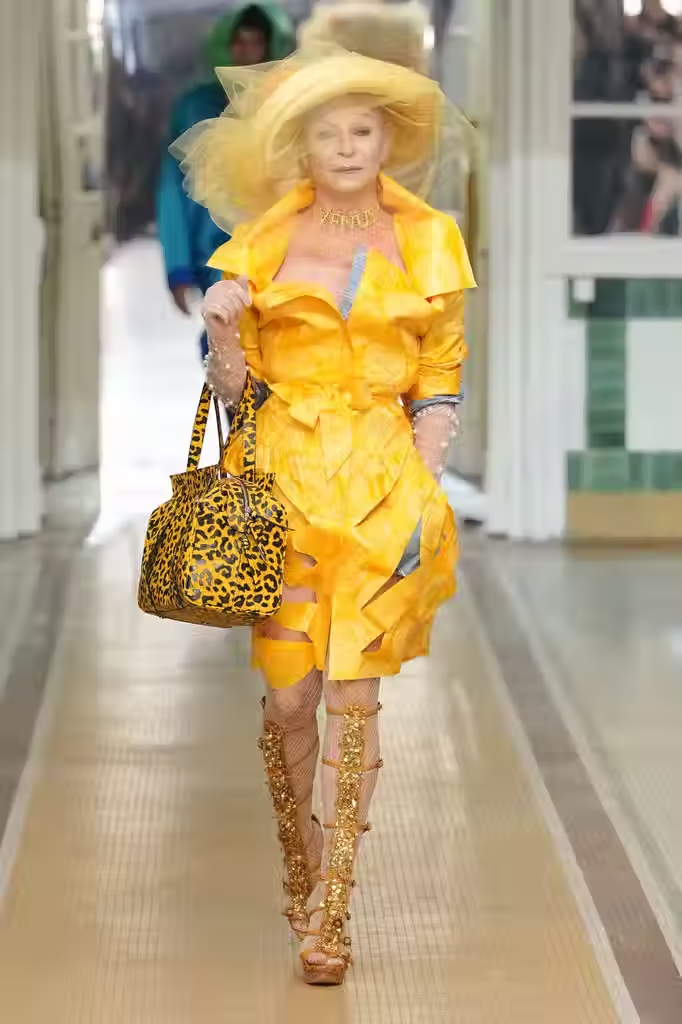
Only a few days into Mercedes-Benz Fashion Week Madrid, color has emerged as one of the most immediate pleasures of the Spring 2027 collections. It is arriving through lime and mandarin, fuchsia and red, botanical prints, multicolored stripes, sequins, flowers and unapologetically saturated combinations. The designers are hardly working from a shared aesthetic, which is precisely what makes the repetition interesting. This is not one prescribed shade appearing across five runways. It is a collective willingness to turn the volume back up. Contemporary coverage from Madrid has already identified flowers, color and celebration among the defining ideas of the opening shows.
Adolfo Domínguez offered perhaps the most thoughtful starting point. Its Spring 2027 collection, Croma, did not simply use color; it investigated it. The house approached the subject scientifically, creatively and emotionally, considering how color exists through the relationship between light, material and the person looking at it. Natural tones were interrupted by lime, pale pink, mandarin, olive, red and yellow, while organza, taffeta, poplin and gauze allowed those colors to shift as surfaces responded to light. Kaleidoscope-inspired sequins and geometric patchworks pushed the idea further.

One of the collection's cleverest ideas concerned color memory. A photographic print drew from the familiar colors of industrial and everyday objects, acknowledging that certain shades become lodged collectively in our minds. We may struggle to describe an exact yellow, but tell someone to imagine a tennis ball and suddenly the color becomes almost universally understood. In Croma, color was not simply decoration. It became something remembered, perceived and shared.
Then Madrid stopped intellectualising it and started having fun.
Celia B made her MBFW Madrid debut with Indian Summer, throwing multicolored stripes, florals, sequins, fringe and enormous bows into the same exuberant world. Football shirts appeared alongside party dresses and ruffled skirts. The combinations could have collapsed under their own enthusiasm, but restraint was never really the proposition. Here maximalism functioned as a method of getting dressed, allowing references accumulated through travel and experience to coexist rather than asking them to politely match.

Ágatha Ruiz de la Prada hardly needed Spring 2027 to grant permission to wear color. She has spent decades refusing the chromatic restraint fashion periodically rediscovers. In Madrid, her familiar graphic shapes, emphatic volumes and intense palette consequently felt less like participation in a new trend than confirmation that everyone else might finally be drifting back towards her territory. There is something satisfying about watching an industry rediscover an appetite a designer never lost.
Agua by Agua Bendita approached abundance differently. Mariana Hinestroza and Catalina Álvarez brought the botanical vocabulary of their Colombian label to Madrid through hand illustration, embroidery, flowers and romantic silhouettes created alongside a network of more than 700 artisans. The landscape appeared through the clothes themselves rather than simply becoming scenery: botanical motifs, embroidered collars and saturated natural references transformed the runway into something lush without losing the specificity of the craft behind it.
And then there was Palomo.

For the label's tenth anniversary, Alejandro Gómez Palomo staged Et in Arcadia Ego in Madrid's Rosaleda del Parque del Oeste. Against an actual rose garden, the clothes became their own fantastical ecosystem. The effect was celebratory, theatrical and gloriously uninte

rested in disappearing into the background. By the time Palomo's birds of paradise had moved through the garden, Madrid's relationship with restraint felt increasingly difficult to defend as coincidence.
What is interesting here is not that Spanish fashion suddenly discovered bright clothes. That would be both inaccurate and considerably less interesting. Ágatha alone could dismantle that argument. The more useful observation is that these collections are arriving at a moment when fashion's broader relationship with color appears to be changing.
The evidence began before Madrid. Spring 2027 menswear already brought stronger full-look color combinations at Celine, Ralph Lauren and elsewhere, prompting Vogue to declare the return of color over summer. New York strengthened the argument. Spring collections there moved through saturated reds, pinks, marigolds and unconventional color combinations, while the clothes outside the shows were similarly experimental.
Madrid now makes that shift considerably harder to ignore. Perhaps that is because color offers something fashion currently seems hungry for: an immediate emotional response. It does not require knowledge of an archive or an explanation of a designer's references to understand what happens when mandarin meets pink, or fuchsia interrupts black and white. Color can make an otherwise familiar silhouette suddenly look strange. It can rescue clothes already sitting in a wardrobe. It can make getting dressed feel less like assembling the correct collection of tasteful objects and more like making a decision.
That does not mean the neutral wardrobe is disappearing. Nor should it. Black will remain black, camel will continue being expensive-looking, and somewhere an exceptionally good grey cashmere sweater is currently being photographed against a travertine wall.
But Spring 2027 is beginning to offer an alternative. The useful takeaway from Madrid is not to identify one winning shade and purchase it immediately. It is almost the opposite. Adolfo Domínguez is exploring how we perceive color. Celia B is colliding it. Ágatha Ruiz de la Prada is celebrating it. Agua by Agua Bendita is growing it. Palomo is turning it into fantasy.
Different designers, different propositions, same increasingly persuasive invitation.
Open the wardrobe. Turn the saturation up.


Comments