
Fashion should make it harder to walk normally
Vivienne Westwood SS27 makes a convincing case for clothes that refuse to behave.
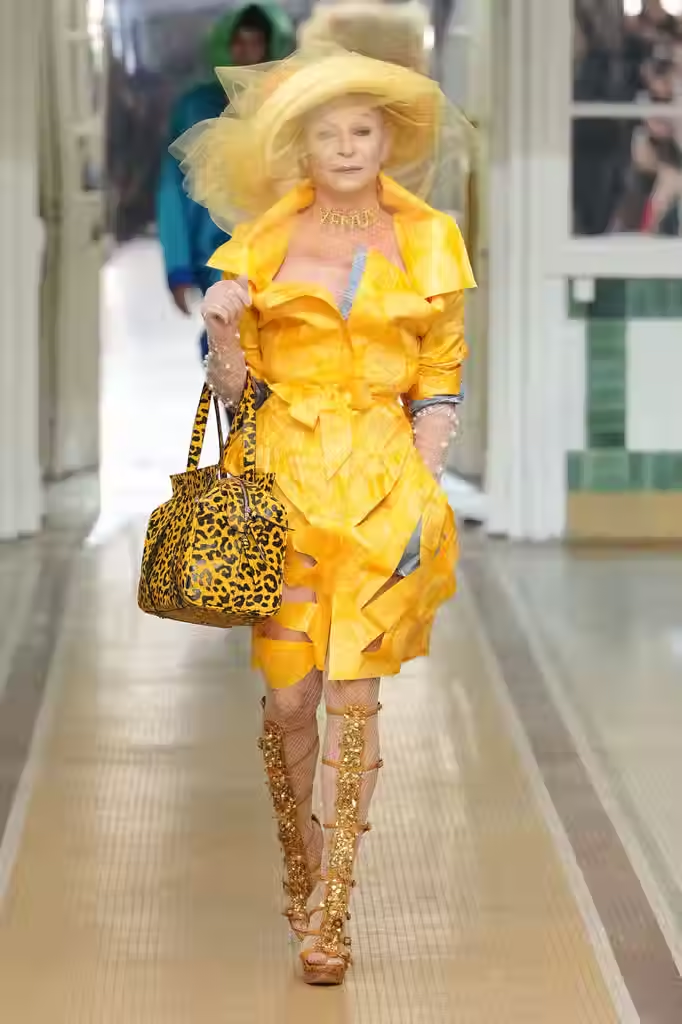
Sometimes clothing requires a small period of negotiation. You work out where the arm goes, reconsider the shoe you thought you could walk in, discover that your skirt has its own preferred direction of travel and accept that sitting down may now require planning permission. Vivienne Westwood has always understood that the second category is considerably more fun.
For Spring/Summer 2027, Andreas Kronthaler built his collection around movement, but not movement in the streamlined, performance-fabric sense fashion usually means when it uses that word. This was movement created by clothes interfering with the body. Huge silhouettes competed with tiny ones. Platforms changed the gait. Fabric gathered, sagged, ballooned and wrapped itself around the wearer. Checks collided with knits, bows appeared where bows probably did not need to be, and familiar garments seemed to have been tugged slightly away from their expected proportions. The body was still moving, but the clothes were having a say in how.
That feels almost rebellious in a fashion culture currently obsessed with making getting dressed as frictionless as possible. We have spent years being sold effortless chic, elevated basics, capsule wardrobes, easy separates and investment pieces that promise to work with everything we already own. Even luxury clothing is increasingly praised for behaving itself. A good garment slips seamlessly into your wardrobe. A useful garment can be worn three ways. The ideal outfit apparently requires so little thought that you should be able to throw it on while leaving the house.

Useful, certainly. Exciting, less reliably.
Westwood has never been particularly interested in clothing disappearing politely onto the body. The house's vocabulary is full of garments that distort it instead: corsetry that rearranges the torso, tailoring that exaggerates the shoulders and hips, draping that shifts the body's apparent proportions, tartan that refuses to recede quietly into an outfit and shoes capable of turning the simple act of crossing a room into an event. The wearer doesn't simply occupy the clothes. The two have to work something out.
There is a difference between discomfort for its own sake and clothing that makes you conscious of wearing it. The latter can be strangely pleasurable. A giant skirt changes the way you move through a doorway. A severe platform changes your posture. An enormous coat gives you more physical presence than your body technically possesses. A corseted waist makes you aware of your silhouette. Clothes can alter behaviour before they alter appearance, and that transformation is part of fashion's appeal.

It is also something the industry's current fixation on practicality can occasionally flatten. There is nothing wrong with owning a perfect white shirt or trousers that work with everything. Most of us need clothes that make life easier. The problem begins when ease becomes the primary measure of whether clothing is good. Taken far enough, the logic of the perfect capsule wardrobe eventually leads to a closet full of exceptionally sensible things and absolutely nothing you are desperate to wear.
Kronthaler's Westwood proposes a much less efficient relationship with getting dressed. The Spring/Summer 2027 collection does not always make the body look longer, slimmer, cleaner or more conventionally elegant. Sometimes it makes it look enormous. Sometimes exposed. Sometimes slightly ridiculous. Sometimes magnificent. A garment can create an awkward shape and still be desirable precisely because the awkwardness is the point.

Vivienne Westwood herself understood this better than almost anyone. Fashion was never simply decoration placed on top of a body. It could manipulate it, exaggerate it, restrict it, expose it and make it perform. Kronthaler continues to play within that vocabulary without turning the house into a museum of Westwood signatures. Movement becomes another way of asking what clothes can actually do to the person inside them.
Perhaps that is why the most memorable fashion is so often mildly inconvenient. The heel is too high. The sleeve keeps falling somewhere strange. The skirt takes up an unreasonable amount of room. The bag holds virtually nothing. You have to think about the outfit while you are wearing it.
Good.
Not every piece of clothing needs to make life easier. Some of it should make walking across the room considerably more interesting.


Comments