
Fashion Is Messing With the Uniform
Rugby shirts, military jackets, school socks and collegiate knits are being pulled out of context for Spring 2027
The uniform has always had a fairly straightforward job. It tells us where someone belongs. A striped tie might identify a school, braid and epaulettes a military rank, a numbered jersey a team, a blazer an institution. Uniforms make people legible before they have introduced themselves, using clothes to communicate membership, authority, profession and status. They are also, by definition, designed to make a group look more alike.
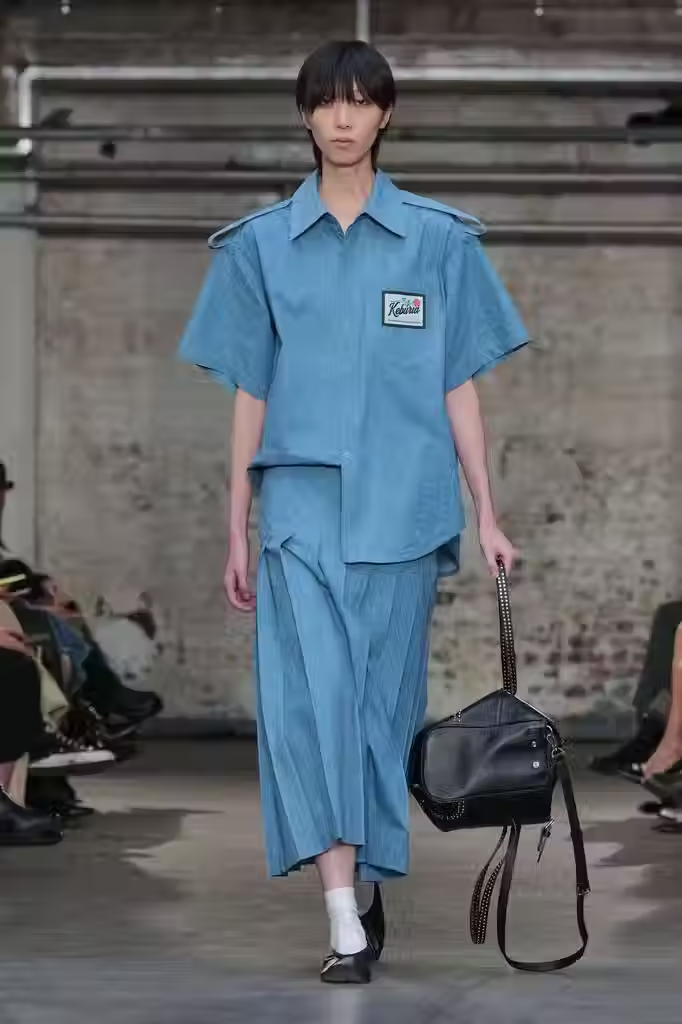
Fashion, naturally, has decided to make a mess of all that. The opening of London Fashion Week brought with it a curious concentration of clothes that looked as though they had been borrowed from institutions with very specific dress codes. Rugby shirts appeared at Mithridate and Keburia. Military braid migrated onto silk shirts and party dresses. Collegiate knits, striped shirts, knee-high socks, strong-shouldered tailoring, officer jackets and equestrian references turned up across collections that otherwise had very little aesthetically in common. Even H&M opened its London spectacle with Alex Consani in an ivory officer-style jacket.

It would be easy to call this another return of prep. Fashion periodically remembers that blazers, rugby shirts and school socks exist, declares collegiate dressing fashionable again and sends everyone searching for loafers. But what happened in London was considerably less tidy.
At Mithridate, Daniel Fletcher looked to the New Romantics, a movement whose relationship with clothes was practically built on refusing to wear things as intended. Fletcher imagined young people raiding costume boxes and stealing rugby jerseys before heading out to clubs, assembling identities from garments that originally belonged somewhere else. Military braiding landed on silk shirts and party dresses. Candy-pink tutus met structured shirting. Corsets emerged from precisely tailored menswear trousers. Collegiate knitwear sat beside garter hooks, tiny shorts and tricorne hats. Even the sporty flat was transformed into a kitten heel.

The uniform was there, but obedience certainly wasn't. That distinction matters. Fletcher wasn't recreating the wardrobe of an English boarding school, military academy or rugby club. He was interested in the possibility of taking clothes loaded with existing meaning and making them communicate something entirely different. A rugby shirt no longer necessarily says sport. A military detail can become decorative rather than authoritative. A collegiate knit removed from its expected trousers, loafers and shirt can stop looking preppy altogether.
Keburia pushed at many of the same codes from another direction. George Keburia's Spring 2027 collection raided British prep-school uniforms, country pursuits, military dressing and sportswear, sending out rugby shirts wrapped around waists, knee-high socks with abbreviated bottoms, exaggerated jackets and equestrian imagery. The effect was less well-behaved country weekend than an institution whose students had collectively decided the dress code was merely a suggestion.
There is something particularly useful about these garments for designers right now. A uniform arrives with meaning already attached. Put an epaulette on a jacket and we recognise authority. Put stripes around a scarf and we understand school or club. A rugby shirt brings sport, masculinity and team identity with it. Knee socks can evoke school before the rest of the outfit has even registered. Designers do not need to explain those references because we have spent our lives learning them.
Which means they can get straight to the interesting part: making them wrong. The idea stretched beyond literal school and sport. Paul Costelloe's Spring 2027 collection returned to the polished power dressing associated with the house's 1980s history, with pronounced shoulders, tailoring, pussy-bow blouses and silk scarves recalling another kind of uniform entirely: the wardrobe of establishment femininity. The clothes once used to communicate that a woman belonged in a particular professional or social world become historical codes themselves, ready to be revisited by another generation.

At H&M's enormous London Fashion Week production, officer jackets appeared alongside corsetry, lace and overtly romantic clothes. Alex Consani's military-style opening look was particularly telling because the jacket's familiar authority was being used primarily for silhouette and attitude. Nobody was likely to mistake it for an actual uniform. That was precisely the point.
Fashion has done this before, of course. School uniforms, naval coats, trench coats, military jackets, varsity sweaters and sporting jerseys have been dismantled and reassembled for decades. Many garments we now consider ordinary fashion began with highly specific practical or institutional functions.
What feels particularly relevant for Spring 2027 is the appetite for keeping those identities visible while deliberately scrambling them. The rugby shirt still needs to look enough like a rugby shirt for the collision to work. The school sock cannot lose all association with school. Military braid is interesting precisely because we recognise its ceremonial authority when it lands on something frivolous. Fashion isn't erasing the original codes. It is depending on our ability to read them, then changing the sentence.

And that makes the idea considerably more useful outside the runway. You do not need a complete prep-school wardrobe to participate in it. In fact, that would rather defeat the purpose. The most interesting version is one institutional piece behaving badly: a rugby jersey against a romantic skirt, an officer jacket over something sheer, a collegiate knit with an evening shoe, knee socks interrupting an otherwise sophisticated dress, a striped men's shirt pulled into a silhouette it was never intended to make.
The tension comes from refusing to finish the reference. Perhaps that is why the uniform feels particularly fertile again. Fashion has spent several years offering us extremely coherent identities. Quiet luxury came with its immaculate knits, discreet bags and beautifully controlled palette. The return of bohemia brought suede, lace and flowing skirts. Prep itself has repeatedly been sold as an entire lifestyle. Each aesthetic arrives with instructions for how its pieces are supposed to coexist.
The emerging uniform story is more interesting because it encourages the opposite.
Take the symbol without accepting the system. Wear the rugby shirt without joining the team. Borrow the military jacket without the discipline. Keep the school sock and lose the schoolgirl. Pull the collegiate sweater away from the campus and the pussy bow away from the boardroom.
Uniforms were created to tell the world where you belong. For Spring 2027, fashion seems much more interested in what happens when you refuse to stay there.


Comments