
These 5 Milan Shows Deserved More Attention
Gucci had the store, Prada had the skirts and Bottega had the crowd. Meanwhile, some very good collections were happening elsewhere in Milan.

Fashion Week attention has never been distributed according to merit. A major creative director can alter the length of a trouser and generate hundreds of headlines before an independent designer has managed to upload the runway images. Celebrity arrivals become news, debuts consume entire days of coverage and the biggest houses arrive with enough cultural machinery behind them to dominate the conversation before the first model has even appeared.
None of that means the attention is undeserved. Gucci, Prada, Ferragamo and Bottega Veneta gave us plenty to discuss this season. But Milan Spring 2027 also contained collections that made us stop scrolling, go back and wonder why considerably more people weren't talking about them. These aren't consolation prizes for smaller brands, nor are they deliberately obscure selections designed to prove how fashion-literate we are. They were simply very good shows.
1. PHAN DANG HOANG

If you managed to scroll past Phan Dang Hoang this season, go back. The Vietnamese designer's Tấm Cám collection began with the Vietnamese folk tale often compared with Cinderella, but thankfully resisted turning cultural heritage into runway costume. Hoang worked instead with the visual world surrounding the story, pulling áo yếm, khăn mỏ quạ headwear, brocade, silk embroidery and Vietnamese craft into a wardrobe that also contained denim, transparency, dramatic volume and distinctly contemporary proportions.
What makes Hoang increasingly compelling is that he doesn't appear interested in making Vietnamese fashion easier for a European audience to understand. Traditional references remain specific rather than being diluted into some vague idea of “Asian influence,” and that confidence gives the clothes their identity. There were moments when embellishment, volume and romanticism all competed for attention, but even the excess felt ambitious. Hoang isn't bringing Vietnamese heritage to Milan to have it validated by Milan. He is demonstrating how much contemporary fashion can be built from a vocabulary that was already there.
2. MARCO RAMBALDI

Marco Rambaldi remains one of those designers fashion people know, editors know and Milan certainly knows, yet the wider conversation repeatedly manages to wander past. That feels increasingly difficult to justify. Rambaldi has spent years constructing an Italian fashion identity with little interest in the immaculate version of Italy that luxury usually exports. His world is younger, queerer, politically engaged, occasionally awkward and deliberately human.
Spring 2027 continued that resistance to polish. The clothes looked inhabited rather than styled within an inch of their lives, which felt particularly relevant during a Milan season increasingly concerned with what happens when fashion returns to actual dressing. Rambaldi understands that personality does not always come from adding another statement accessory or manufacturing an instantly recognizable runway silhouette. Sometimes it comes from allowing clothes to look as though someone has already lived in them.
That might be less immediately viral than a celebrity carrying a new handbag into a show, but it creates the kind of identity that is considerably harder for another brand to manufacture next season. Milan talks constantly about Italian fashion heritage. Rambaldi offers a useful reminder that contemporary Italian identity is also being built by designers who have very little interest in behaving like its traditional luxury establishment.
3. HUI

Milan likes to describe itself as an international fashion capital, but there is still a tendency to treat designers arriving from elsewhere as visitors to the Italian system. HUI complicates that hierarchy. Founded by Chinese designer Hui Zhou Zhao, the label has spent years showing in Milan while building collections around a conversation between Chinese cultural memory and contemporary fashion rather than treating one as decoration for the other.
That distinction matters. Chinese references in European fashion have historically had an unfortunate habit of becoming shorthand: embroidery, red silk, dragons, porcelain prints and whatever else can communicate “China” quickly enough from the back row. HUI's work is more interesting when it resists that instant legibility. Cultural references become part of the construction of a contemporary wardrobe rather than proof of where the designer comes from.
Spring 2027 belonged to that continuing conversation. The collection carried the confidence of a designer who no longer needs to choose between Chinese identity and an international fashion context, because the assumption that those things are opposites is increasingly outdated. HUI doesn't need to become less Chinese to belong in Milan, nor does showing in Milan somehow transform the work into European fashion.
For a publication interested in what happens when fashion stops treating geography as hierarchy, that makes HUI particularly worth watching.
4. FRANCESCO MURANO
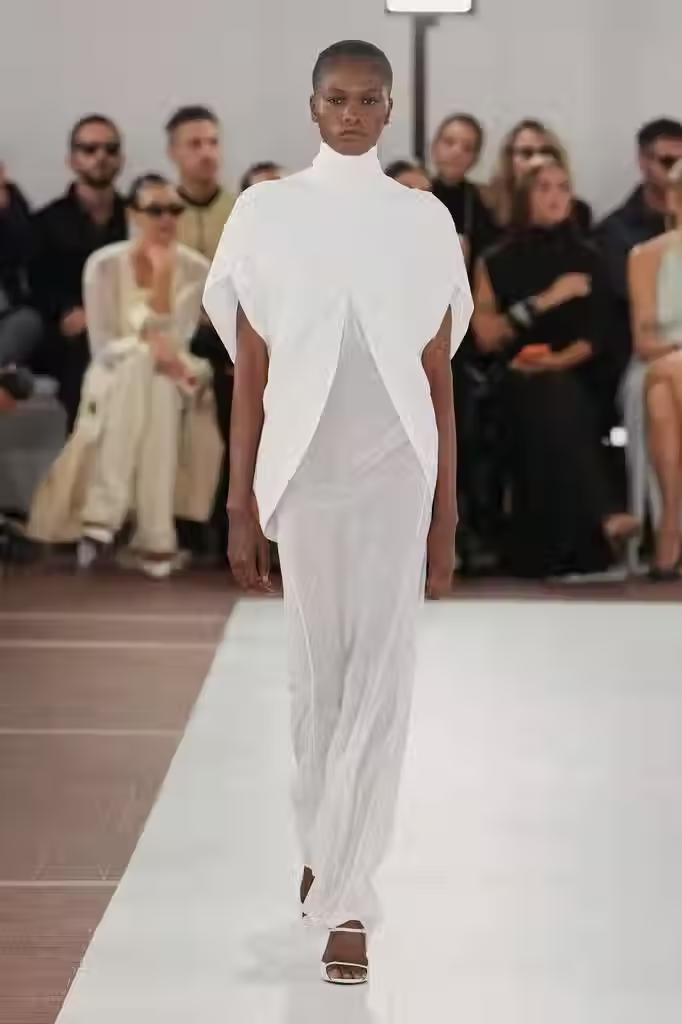
Francesco Murano understands something fashion occasionally forgets: a dramatic garment does not necessarily need dramatic styling to prove that it is dramatic. His work has long explored sculptural construction, tailoring and the tension between exposing and concealing the body, and Spring 2027 continued that investigation with a welcome amount of restraint.
There is confidence in knowing when a garment has already said enough. Milan, like the rest of fashion month, contained plenty of evidence of the opposite instinct. Add the strange shoe, add another belt, distort the proportion, put something on the head and make absolutely certain nobody could accuse the look of being under-styled. Murano's strongest pieces didn't require that assistance. Construction created the interest, silhouette supplied the drama and the body remained part of the composition rather than disappearing beneath the styling.
That restraint shouldn't be mistaken for simplicity. Making something complicated look resolved is considerably more difficult than piling ideas onto it until complexity becomes the aesthetic. Murano's strongest Spring 2027 looks understood the difference. Sometimes fashion really can just give us an excellent dress and trust us to notice. The algorithm will survive.
5. SPORTMAX

Sportmax may not qualify as an undiscovered name, but its Spring 2027 collection deserved a considerably bigger conversation than it received. The premise was almost aggressively practical: what are people actually supposed to wear when cities are becoming unbearably hot but work, commuting and everyday life continue to demand clothes?
Rather than producing another fantasy summer wardrobe designed for someone permanently standing beside the Mediterranean, Sportmax looked at workers and commuters navigating heat in cities including Milan, Venice, Paris and Tokyo. Familiar office clothes were stripped back and reconstructed for temperature rather than convention. Pinstripe tailoring appeared in voile and lightweight viscose, panels opened across otherwise recognizable silhouettes and traditional assumptions about what constitutes a professional wardrobe began to loosen.
There is something particularly refreshing about a collection responding to climate without immediately turning itself into a sustainability lecture. Sportmax wasn't asking the clothes to save the planet. It was acknowledging that the planet has already changed the conditions under which people get dressed. That produces a much more immediate design problem: if extreme summer heat is increasingly normal, why are wardrobes still being constructed around seasonal assumptions that no longer reflect the way many people actually live?
It was a deceptively straightforward collection with a genuinely contemporary question underneath it, and exactly the kind of show that gets lost when Fashion Week attention is concentrated around creative-director debuts and blockbuster houses.
THE BIGGEST SHOW ISN'T ALWAYS THE ONE WORTH TALKING ABOUT
None of these collections needed Gucci, Prada or Bottega Veneta to be bad in order to be good. The problem begins when visibility and importance become interchangeable, because Fashion Week then becomes an exercise in watching the brands we already know are important confirm their importance again.
The real pleasure of a week containing this many collections should be discovery. It is finding the designer who makes you open another tab, the collection you immediately send to someone else, or the show you somehow missed while the rest of the industry was arguing about the latest interpretation of a century-old house. That discovery becomes even more interesting when Milan itself stops being treated as a purely Italian conversation. Phan Dang Hoang and HUI brought Vietnamese and Chinese perspectives into the week without surrendering their specificity to the city hosting them, while Rambaldi, Murano and Sportmax offered three very different propositions for what contemporary Italian fashion can look like.
Milan gave its biggest houses plenty of attention for Spring 2027. They will be fine. These five deserved some of it too.


Comments