
Sara Pedram turns Persian mythology into couture
At Dubai Fashion Week, the Iranian designer draws on ancient poetry, mythical birds and traditional craftsmanship to create a collection about transformation, resilience and the enduring power of cultural storytelling

There is something particularly compelling about fashion that draws from mythology without reducing it to decoration. At Dubai Fashion Week, Iranian designer Sara Pedram presented Simurgh, a Spring/Summer 2027 couture collection inspired by one of Persian literature's most enduring symbols. Through sculptural silhouettes, intricate embroidery and painterly surfaces, Pedram explored the idea of transformation, using clothing to translate centuries-old stories into something unexpectedly personal.
The collection takes its name from the Simurgh, a mythical bird associated with wisdom, renewal and spiritual transformation. Its narrative draws on The Conference of the Birds, the 12th-century allegorical poem by Persian writer Farid ud-Din Attar, in which a gathering of birds undertakes a difficult journey in search of their legendary sovereign. The story ultimately becomes an exploration of self-discovery, with the birds discovering that the wisdom they seek cannot be separated from their own collective experience.

For Pedram, who was born in Shiraz and established her label in 2015, the reference offered a way to connect cultural heritage with more intimate questions of identity and resilience. Her interpretation was not concerned with recreating historical Persian clothing. Instead, she borrowed the symbolism of flight, transformation and renewal, allowing these ideas to influence the shape, movement and surface of contemporary couture.
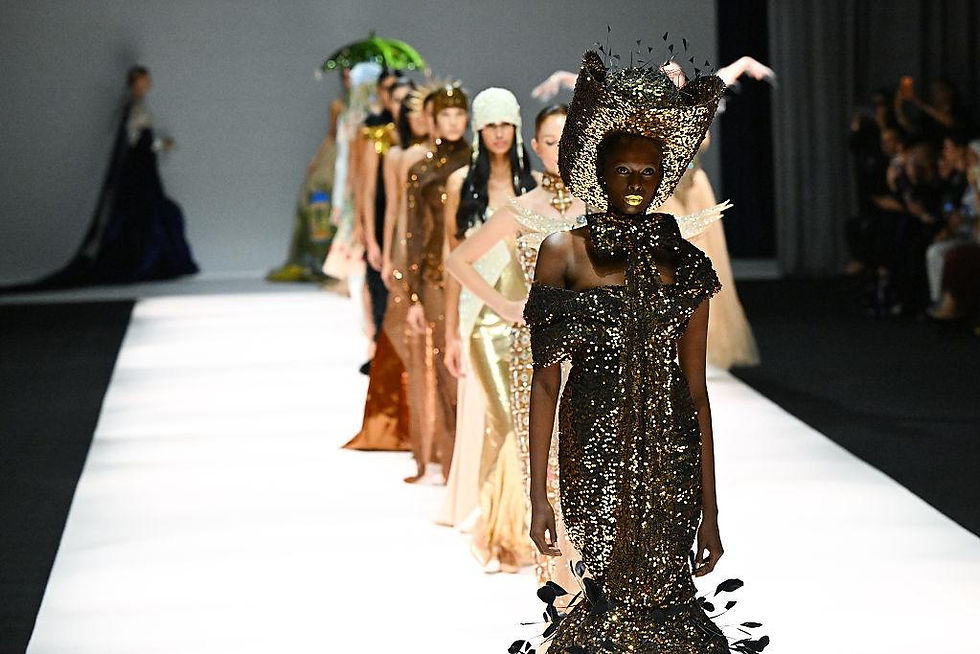
A ballerina opened the presentation, introducing a sense of movement before the first gowns appeared. Sheer fabrics extended into wing-like structures at the shoulders, while sculptural silhouettes suggested the tension between the human body and something more fantastical. Elaborate embellishment was central to the collection, but its strongest moments came when ornamentation contributed to the narrative rather than simply demonstrating technical extravagance.
A burnt-umber column gown combined dense embellishment with cascading paillettes that moved with the wearer, creating a sense of shifting light. Elsewhere, a Prussian-blue velvet gown featured a Tree of Life traced in Swarovski crystals across its train. The symbolism was unmistakable, yet the richness of the velvet and the precision of the embellishment gave the piece a visual authority beyond its literary reference.
Perhaps the most interesting garment was also the least conventionally luxurious. A voluminous gown constructed from rough hessian featured a hand-painted scene inspired by the poetry of Hafez, another celebrated figure of Persian literature. Against the polished surfaces and intricate embellishments elsewhere, the coarse material introduced an unexpected contrast. Its appeal lay in the suggestion that beauty does not depend entirely on precious fabric or immaculate finishes, and that a material's expressive possibilities can be more important than its perceived value.
That contrast revealed both the collection's strengths and its occasional limitations. Couture inspired by mythology can easily become overly illustrative, particularly when every garment is expected to carry an identifiable symbol. Pedram was most convincing when she allowed the materials themselves to communicate, whether through the movement of a shoulder extension, the weight of velvet or the irregular texture of painted hessian.

There is also a wider cultural significance to the presentation. Persian artistic traditions have influenced fashion for centuries, yet their representation in contemporary luxury frequently stops at decorative motifs and familiar historical references. Pedram's collection suggested a more personal relationship with that heritage, drawing on literature not simply as an aesthetic resource but as a framework for examining experiences that remain relevant today.
At a fashion week often associated with glamorous eveningwear and spectacular embellishment, Simurgh offered a reminder that craftsmanship becomes considerably more interesting when it has something to communicate. The collection was undeniably theatrical, but beneath its elaborate surfaces was a quieter proposition about resilience, memory and the possibility of renewal.
For Sara Pedram, the mythical bird was never merely an ornamental reference. It became a way of exploring how identity can survive change, and how the stories inherited from one culture can continue to find new forms of expression.


Comments