
New York Has Finished Making Its Case for Spring 2027
After a week of color, romance, strange proportions, serious craft and a welcome return of personality, these are the ideas we are taking away from NYFW

Fashion weeks rarely deliver the clean seasonal reset that trend reports would have us believe. Seventy designers do not collectively decide that everyone should wear the same skirt next spring. What emerges instead is a mood, visible in the ideas that keep appearing in different forms and for entirely different reasons. New York’s Spring 2027 season had plenty of those repetitions, and perhaps the clearest was a rejection of fashion becoming too neat.
This was a week with room for Michael Kors’s crisp modernism, Khaite’s newfound romance, Tory Burch’s eccentric femininity, Calvin Klein’s disciplined reduction, Coach’s birthday-party exuberance, Rachel Scott finding greater confidence at Proenza Schouler and AREA gleefully making dresses from jump ropes. Even when designers disagreed aesthetically, they frequently arrived at the same broader conclusion: clothes could have character again.
And that gives us plenty to talk about.
The Minimalist Hangover Is Wearing Off
Minimalism did not disappear in New York. Calvin Klein made an extremely persuasive argument for it, stripping the wardrobe back to slips, slim skirts, trousers, T-shirts and jackets. But elsewhere, the instinct was increasingly to add.
Khaite's Catherine Holstein practically said as much. Where she once approached collections by asking what could be removed, Spring 2027 had her asking what could be added. The result brought lace, corsetry, ruffles, lingerie references and delicate hand finishing into a label strongly associated with darker, harder New York cool. Tory Burch piled crystals onto tie-dye, threaded shark teeth through necklaces and sent out hand-painted silk feathers. Cult Gaia worked with metallic discs, florals and organza. Coach eventually abandoned its subdued opening for sequins, metallics and literal birthday-party accessories.

The important distinction is that this does not look like a straightforward return to maximalism. Spring 2027 is shaping up to be more interesting than that. A simple silhouette might carry an extraordinary surface. A familiar cardigan might be deliberately misbuttoned. A restrained outfit might suddenly acquire an enormous accessory. The new proposition is less “more is more” than give the eye somewhere interesting to go.
Romance Is Getting Weird Again
Romance returned, but New York was suspicious of anything too perfect. Ralph Lauren called his collection an “irreverent take on romance,” pairing corsetry and brocade with cargo trousers and distressed denim. Khaite looked towards antique lingerie but left construction visible and closures undone. Tory Burch engineered dresses to appear as though they were slipping apart. Cult Gaia’s florals emerged alongside shells, metallic constructions and hand-treated organza. Christian Siriano embraced corsetry, historical fantasy and unabashed glamour.

That imperfection matters. The prettiness arriving for Spring 2027 is crumpled, displaced, sheer, asymmetric, frayed or interrupted. A bow can be enormous. A corset can escape the evening gown. Satin does not have to look pristine. Romantic dressing is coming back with its hair slightly messed up.
Color Has Its Confidence Back
Perhaps one of the easiest conclusions from New York is simply this: prepare for color. Michael Kors built his modernist collection around saturated red, yellow, green and blue against black and white. Henry Zankov brought his instinct for fearless color and pattern into his debut at Diane von Furstenberg. Proenza Schouler introduced vivid velvet tailoring and graphic animal motifs. Meanwhile, the streets outside the shows were equally persuasive, mixing burgundy, chartreuse, teal, pink, red and blue rather than treating one fashionable shade as the prescribed color of the season.

More interesting than any individual shade was how color was being combined. The strongest looks did not necessarily rely on perfect tonal harmony. They clashed. They interrupted neutrals. They allowed one strange shade to alter an otherwise conventional outfit.
That feels considerably more useful than declaring one particular green “the color of Spring 2027.”
Texture May Matter More Than Print
If color was one story, surface was another. Sequins appeared at Ralph Lauren, Coach and Cult Gaia. Lace moved through Khaite. Tory Burch explored crystals, chenille, beads and feather-like silk. Fringe appeared both on the runway and in the streets. Proenza Schouler worked intarsia-like constructions and embellishment into its clothes. Libertine, naturally, treated the entire concept of an undecorated surface as something of a personal affront.
Early assessments of the season have similarly picked out dynamic fabrics, shimmer, fringe, sheerness and embellishment as recurring ideas. Spring may therefore be less about choosing between floral, stripe or check than deciding whether something should shimmer, float, crunch, fray, sparkle or move.
We vote for move.
Sheer Hasn't Gone Anywhere, but It Is Growing Up
Transparency survives another season, although the more interesting examples suggested that the naked-dress conversation may finally be evolving. Sheer fabrics appeared as layers, jackets, skirts, lingerie references and textural interruptions rather than functioning solely as vehicles for displaying the body. At Khaite, transparency belonged to a broader romantic vocabulary. Proenza Schouler used slinky evening pieces with relaxed styling. Across the week, sheer dressing was repeatedly identified alongside fluid satin and lingerie construction.

The distinction is subtle but important. Transparency becomes much more useful when treated as material rather than exposure. Layer it, interrupt it, put something substantial beside it. That offers considerably more longevity than another season of strategically placed crystals over nude mesh.
Tailoring Is Loosening Its Tie
New York still loves a jacket. It simply seems less interested in wearing one correctly. Proenza Schouler put strong tailoring into vivid velvet. Tory Burch revisited broad 1940s shoulders and high waists. Coach softened traditional tailoring through washed, garment-dyed jersey. Michael Kors sliced silhouettes asymmetrically. Meanwhile, street style was full of belts worn over clothes rather than through loops and scarves used almost like cummerbunds.
That may prove one of the season's most wearable ideas. The suit itself does not need replacing. Its styling does. Wear the jacket too large. Cinch it somewhere unexpected. Add a brooch. Put something sheer underneath it. Separate it from its matching trousers. Introduce a scarf at the waist. Let formalwear collide with something casual.
The wardrobe staple survives because fashion keeps finding new ways to annoy it.
Accessories Are Becoming Part of the Outfit Again
For several years, accessories could feel like the final administrative task of getting dressed: sensible bag, simple shoe, tiny jewellery, done. Spring 2027 has other plans.
Michael Kors showed sculptural metal-handled bags, oversized eyewear, pendants, long scarves and white go-go boots. Tory Burch made deliberately strange microbeaded pumps and substantial shoppers. Coach dismantled and reconstructed familiar bags while turning gift boxes into purses. Proenza Schouler brought back the spirit of the PS1 through the softer PS1 Walker. On the streets, belts were doubled, scarves moved around the body, bags became more conspicuous and pointed shoes punctuated outfits.
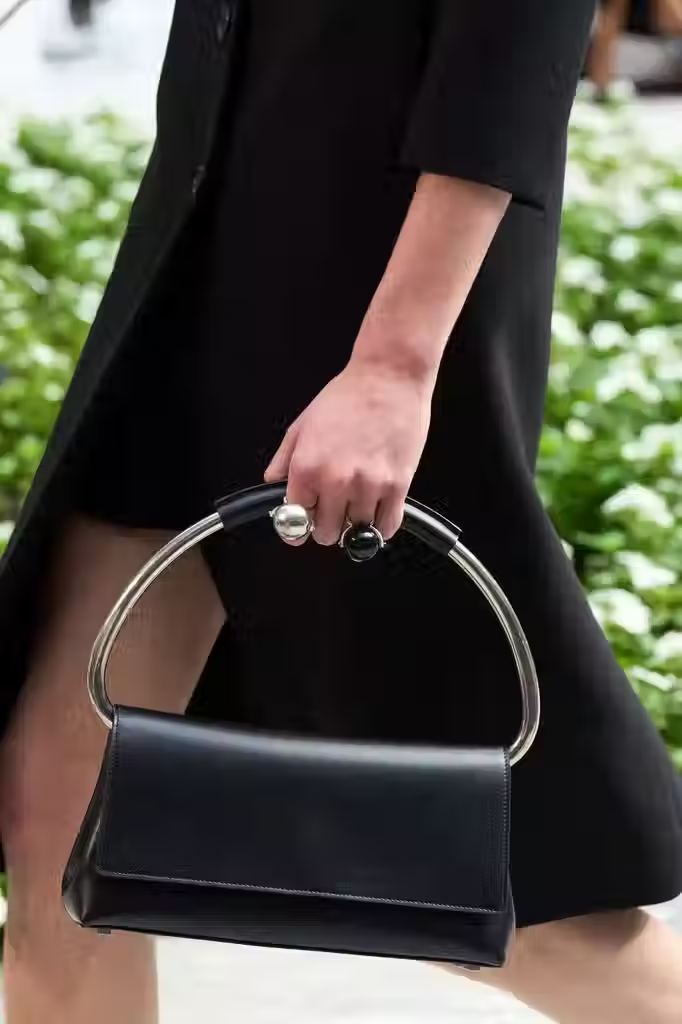
Even the cummerbund has somehow entered the conversation, appearing in contemporary interpretations on and around the Spring 2027 shows. This is good news. Accessories are most exciting when they change an outfit rather than simply complete it.
Craft Is Becoming Something Designers Want Us to Notice
One of the more serious currents running beneath all this exuberance was the visibility of making. We saw hand-tatted lace at Khaite, hand-painted silk at Tory Burch, intricate surface treatments at Libertine and highly involved textile construction at Proenza Schouler. Rachel Scott has spoken specifically about the importance of the human hand in her work, while designers across the calendar allowed stitching, embellishment, irregularity and process to remain perceptible rather than polishing every trace of making away.
That connects neatly with a larger conversation happening in luxury. As prices rise, “craftsmanship” cannot remain a vague word printed in a campaign. Clothes that allow us to see where skill, labor and experimentation entered the process make a stronger argument for their own value.
The Most Important Trend Was Personality
This is the takeaway we keep returning to.
New York did not present one dominant woman for Spring 2027. It presented many. The Calvin Klein woman could coexist with the Libertine woman. Khaite could suddenly become romantic without surrendering its identity. Michael Kors could embrace primary color without losing polish. Coach could celebrate 85 years by looking forward rather than embalming its archive. Rachel Scott could respect Proenza Schouler while increasingly making it her own.

And outside the shows, people were doing much the same thing. Pattern was colliding with pattern. Animal print appeared beside tailoring. Scarves migrated from necks to waists. Burgundy shared space with much stranger colors. Practical flats existed alongside pointed heels. The overall impression was less about adherence to a particular aesthetic and more about visible evidence that someone had actually styled the clothes.
After years in which algorithms turned microtrends into uniforms at extraordinary speed, that may be the most encouraging proposition New York offered. Spring 2027 does not appear to be asking us to throw away our wardrobes and begin again. Quite the opposite. It asks what happens when we interfere with them.
Add the strange tights. Put the brooch on the blazer. Clash the colors that supposedly do not belong together. Wear satin during the day. Disturb the tailoring. Let the lace show. Choose the bag with personality. Stop saving the extravagant thing for an occasion worthy of it.
New York's strongest message was not that fashion needs more clothes. It was that getting dressed could use more imagination.


Comments