
Maximilian Davis Is Making History Feel Sexy Instead of Sacred
As Ferragamo approaches its centenary, Maximilian Davis keeps returning to the archive without allowing himself to become trapped inside it

Fashion has developed a complicated relationship with its archives. At heritage houses, every incoming creative director is expected to study the codes, identify the icons and demonstrate an appropriate level of respect for whatever happened before them. The result can be collections that are impeccably researched but strangely lifeless, as though history has become an instruction manual rather than somewhere to begin.
Maximilian Davis has been steadily finding another way at Ferragamo. For Spring 2027, he returned to the 1940s, looking partly to Lee Miller and the utilitarian wardrobes of women working during wartime. There were references to uniforms, workwear, practical pockets and the restrained silhouettes of the period, but very little about the collection felt interested in historical accuracy. Instead, Davis took those references apart and rebuilt them through the increasingly sensual vocabulary he has established at Ferragamo.

Latex appeared against sheer silk. Utilitarian shapes were pulled closer to the body. Belts wrapped and interrupted silhouettes, while pleating, transparency and exposed skin complicated the severity associated with wartime dress. The tension was precisely what made the collection interesting. Davis wasn't asking us to admire the elegance of the 1940s from a respectful distance. He was asking what those clothes could become once their original rules no longer mattered.
HISTORY AS MATERIAL, NOT INSTRUCTION
That distinction is becoming increasingly important as Ferragamo approaches its centenary in 2027. A hundred years of history gives a designer an extraordinary amount to work with, but it also creates an obvious temptation to turn the anniversary into a parade of recognizable codes. Heritage houses know that archives sell, particularly at a moment when luxury customers are being encouraged to value provenance, craftsmanship and permanence. The danger is that reverence can quickly become creative paralysis.
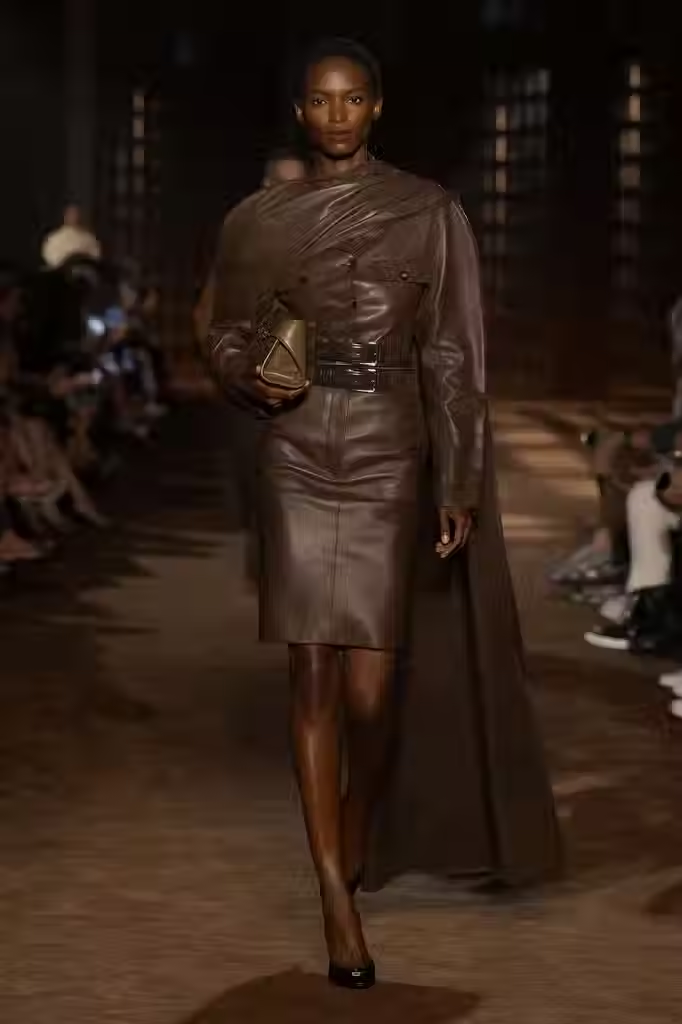
Davis seems increasingly comfortable avoiding it. His Ferragamo has repeatedly looked backward, from Renaissance dress and Hollywood glamour to archival footwear and different periods of Italian history, but the references rarely arrive intact. He extracts something useful from them, whether a proportion, material, construction or attitude, then allows the rest of the collection to belong to the present.
Spring 2027 makes that approach particularly visible because the source material could so easily have become costume. A literal interpretation of wartime dressing would have given Ferragamo plenty of beautifully tailored coats, military references and sensible nostalgia. Davis instead found sensuality inside utility. The severity of the period became something to push against, allowing latex, transparency and the body to prevent the history from becoming too polite.

There are moments when that translation works better than others. Davis can occasionally become so committed to refinement that Ferragamo loses some of the friction that makes his strongest ideas exciting. Not every historical reference needs to be immediately legible, but neither should the process of stripping it back leave the clothes without enough character of their own. The strongest looks here are the ones where the collision remains visible, where practicality and sensuality seem to be arguing with each other rather than settling into perfect harmony.
That tension may ultimately be more useful to Ferragamo than another exercise in immaculate heritage dressing. A century-old house does not need a designer to prove that its history matters. The archive has already survived long enough to establish that.
What it needs is someone willing to do something with it. Davis increasingly treats Ferragamo's past not as a set of instructions to follow, but as raw material to cut, distort, sexualize and occasionally disregard. As the house approaches 100, that might be the more interesting form of respect: not preserving history exactly as it was, but making sure it still has somewhere to go.


Comments