
Madrid Didn't Need One Aesthetic to Have an Identity
From Palomo's extravagant Arcadia to Moisés Nieto's quiet Andalucía, Madrid's most interesting proposition for Spring 2027 was not a single definition of Spanish fashion, but the freedom to have many

There is a temptation whenever a fashion week takes place outside Paris, Milan, London or New York to search for the thing that makes it local. What does Spanish fashion look like? What does Seoul fashion look like? What is the Copenhagen aesthetic? The questions sound reasonable enough, but they contain an expectation we rarely impose on the largest fashion capitals. Nobody watches Paris waiting for Saint Laurent, Comme des Garçons and Chloé to arrive at a collective definition of Frenchness.
Madrid's Spring 2027 season made the limitations of that thinking particularly obvious.
Across six days, Spanish fashion moved through wildly different ideas of itself. There was Adolfo Domínguez examining color with characteristic intellectual restraint, Ágatha Ruiz de la Prada continuing her exuberant pop universe, Moisés Nieto returning to the official schedule with a deeply personal meditation on Andalucía, Palomo celebrating ten years by constructing an Arcadia of beauty and transformation, and Custo Barcelona doing what Custo has spent decades doing: treating color, surface and self-expression as reasons enough to get dressed. Yolancris closed its own corner of the week with Ophelia, an intensely romantic exercise in flowers, craftsmanship and femininity.

These collections did not agree with one another. That was precisely the point. Perhaps the clearest demonstration came from two designers looking toward the same part of Spain. For his tenth anniversary, Alejandro Gómez Palomo returned to the language that has made Palomo one of the country's most internationally recognisable contemporary labels. Et in Arcadia Ego, staged among the roses of Madrid's Parque del Oeste, imagined an idealised territory in which desire, beauty and identity could exist with fewer rules. Palomo described wanting the collection to be unmistakably his, and it was: fantastical, theatrical and committed to the transformative possibilities of getting dressed.
Moisés Nieto looked toward Andalucía too and found almost the opposite. Returning to the official Madrid calendar after nearly a decade away, Nieto deliberately avoided the most exportable images of southern Spain. There were no easy piles of ruffles, flamenco shorthand or obligatory flowers tucked into hair. His Andalucía was darker and more internal, shaped by childhood, mourning, village life, secrets, working women and the strange release of the local verbena after the restraint of everyday life. Black became a color of memory rather than absence, interrupted by moments of brightness and celebration. Nieto has described the Andalucía he knows as quieter, darker and more introverted than the version usually sold to the outside world.

Both collections were Spanish. Both were Andalusian. Neither invalidated the other.
That distinction matters because fashion has a habit of turning geography into aesthetic shorthand. Spain becomes flamenco, sensuality, red and black. Scandinavia becomes minimalism. Japan becomes conceptualism. India becomes embellishment. Africa becomes print and craft. Entire creative cultures are compressed until they become immediately legible to an international audience.
Legibility is useful. It is also limiting. What Madrid offered this season was something messier and ultimately much more interesting: designers drawing from where they come from without being required to produce the same answer.
Even color refused to behave consistently. Adolfo Domínguez's Croma treated it as omething to investigate, asking how color is perceived and remembered rather than simply deploying it decoratively. Elsewhere, Celia B allowed stripes, florals, sequins and sporting references to collide with cheerful abandon, while Ágatha Ruiz de la Prada continued to operate inside a chromatic universe so distinctive that restraint would feel considerably more radical than another explosion of color. Custo Barcelona softened parts of its familiar intensity with pastels for Spring 2027 without surrendering the shine, textile experimentation and energetic combinations that have made the label identifiable around the world.

The difference between those approaches is more useful than any attempt to identify a collective palette. The same could be said of how Madrid's designers approached tradition. Some confronted it directly. Some distorted it. Some seemed entirely uninterested in proving their Spanishness at all. Yolancris made flowers central to Ophelia, but the emphasis was on the relationship between nature and craftsmanship rather than on a recognizable national motif. The collection's romanticism belonged to the particular universe Yolanda Pérez has built around the label, just as Custo's visual energy belongs to his.
That plurality extended beyond the clothes. For the first time, the entire MBFWM programme moved out of IFEMA and across Madrid, with shows staged at the Invernadero del Palacio de Cristal de Arganzuela, Palacio de Cibeles, Universidad Nebrija and a series of additional locations throughout the city. Palomo occupied the Rosaleda del Parque del Oeste; other designers moved through hotels, gardens and institutional spaces. The decision was part of a deliberate effort to make Madrid itself more present in its fashion week rather than treating the event as something happening inside an exhibition complex at the edge of it.
That change feels significant beyond logistics. A fashion city becomes more convincing when it stops trying to manufacture a single image of itself.
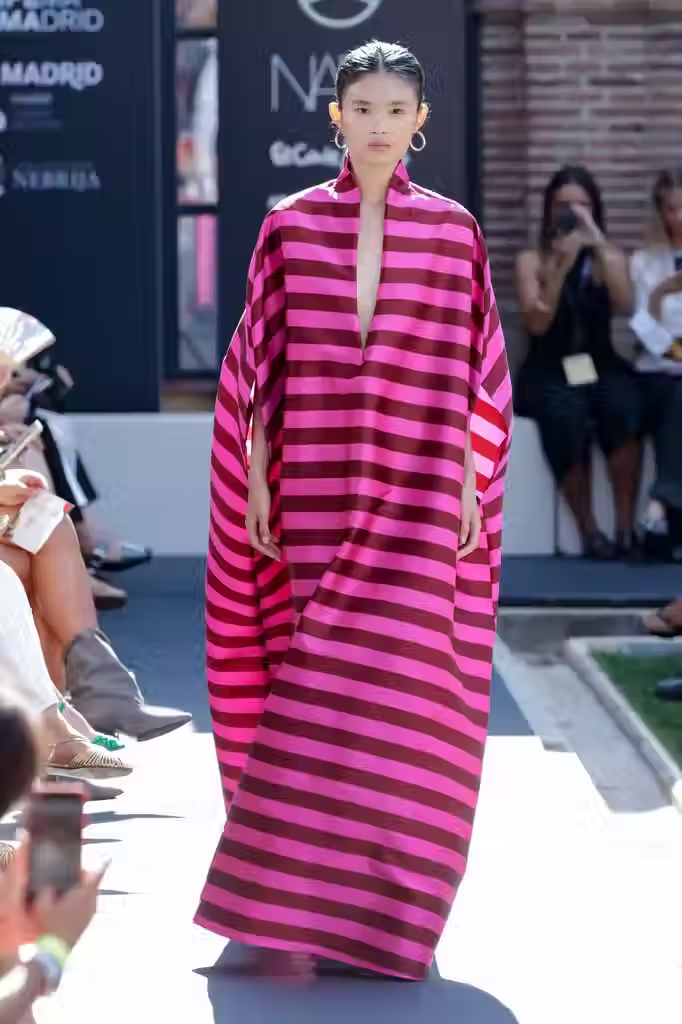
Madrid does not need to become the capital of a particular silhouette, color palette or lifestyle. Nor does Spanish fashion need an easily exportable aesthetic identity to justify international attention. The ecosystem becomes more interesting when Palomo's theatrical fantasy can exist beside Nieto's restraint, when Yolancris's romantic craftsmanship can share a calendar with Ágatha's pop exuberance, and when an established global business like Custo can occupy the same conversation as the young designers closing the week through EGO.
That final day made the argument especially clear. The EGO platform, celebrating its twentieth anniversary, brought together Apolíneo Studio, Biyeyemete, Cotes, Isabel Is My Name, Karla Aguilar and Miss Take. They were not presented as the custodians of a prescribed Spanish aesthetic, but as six emerging propositions for what might come next.

There is something healthier in that. Fashion's traditional capitals have historically been allowed complexity. Paris can be bourgeois and avant-garde, severe and romantic, commercial and experimental, all within the same afternoon. Milan can contain Prada and Dolce & Gabbana without anyone demanding that one of them provide the definitive version of Italian fashion. London has practically built its international reputation around contradiction.
Smaller or less internationally dominant fashion markets deserve the same freedom. A strong fashion identity does not necessarily emerge when everybody begins speaking the same visual language. Sometimes it appears when a creative community becomes confident enough to stop trying.
Madrid's Spring 2027 season did not give us one neat answer to the question of what Spanish fashion looks like. It gave us a better question: why should it have to?


Comments