
Loewe just got a little more American. That might be exactly what it needed.
For their second Loewe collection, Jack McCollough and Lazaro Hernandez stopped worrying quite so much about the house they inherited and allowed more of themselves into it.

Taking over Loewe after Jonathan Anderson must be one of fashion's more intimidating assignments. Anderson did not simply leave behind a successful collection of clothes and handbags. Over eleven years, he constructed an entire intellectual ecosystem around the Spanish house, combining extraordinary craft with art-world credibility, surrealism, deliberately awkward proportions and objects that frequently seemed designed to become internet discourse before they became products. A Loewe collection could contain a dress shaped like a car, a pixelated hoodie, a coat sprouting grass or a pair of shoes with balloons for heels and somehow still feel unmistakably connected to the same universe as an impeccably made leather bag.
Jack McCollough and Lazaro Hernandez therefore inherited something more difficult than an archive. They inherited a recent memory. Everyone watching their first collections knew exactly what Loewe had looked and felt like five minutes earlier, which meant almost every decision invited comparison with Anderson. Too familiar and they risked looking like custodians of someone else's success. Too different and they risked dismantling one of luxury's most valuable contemporary identities before establishing an alternative.
Spring/Summer 2027 begins to show how they might escape that problem. Their answer is not to find an even stranger version of Loewe or to compete with Anderson on intellectual eccentricity. Instead, they are bringing something into the house that could initially seem almost incompatible with it: Americanness.

McCollough and Hernandez described the collection through the tension between what they called the “ease of American pragmatism” and Spain's “drama, ritual, history.” It is the kind of fashion-show language that can sound suspiciously neat until the clothes start making the argument themselves. Basketball-jersey shapes were transformed into beaded slip dresses. Sporty piping travelled across far more polished garments. Backwards baseball caps appeared with precise tailoring. Capri trousers carried an echo of bullfighter breeches without becoming literal costume. American sportswear and Spanish references were not separated into opposing halves of the collection. They were allowed to interfere with each other.
That interference is where their Loewe becomes interesting.
McCollough and Hernandez are not outsiders to European luxury, but their design education is unmistakably American. They founded Proenza Schouler in New York in 2002 and built their reputation through a particularly New York understanding of sophisticated sportswear: clothes with intellectual ambition that still belonged to the realities of a wardrobe. American fashion has historically excelled at precisely this negotiation. It borrows from sport, uniforms, workwear and practical clothing, then manipulates those references until usefulness and fashion become difficult to separate.
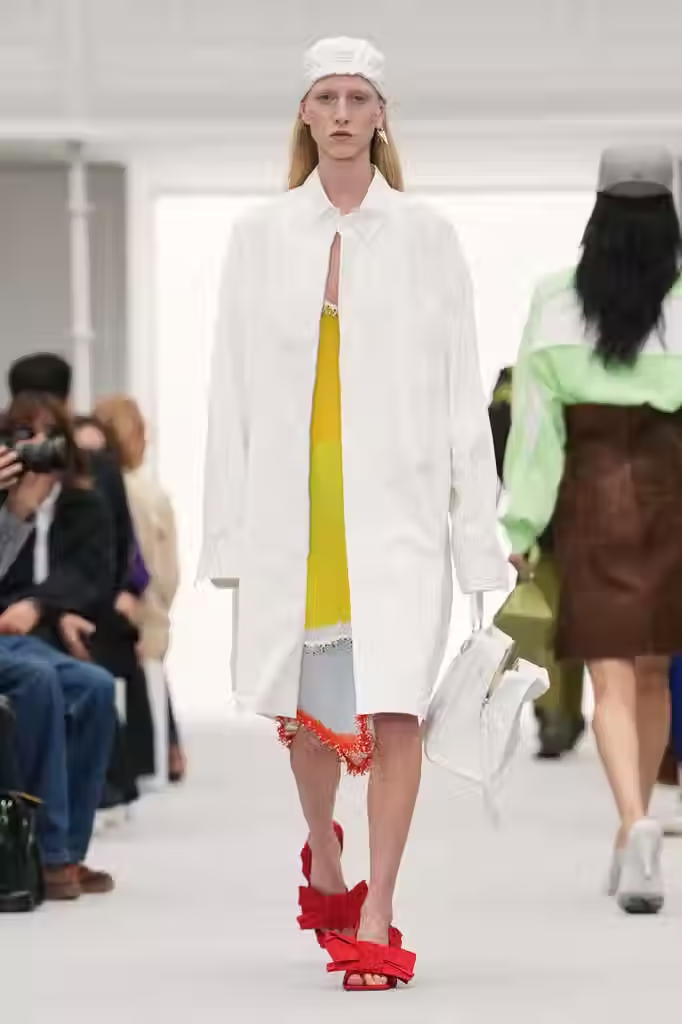
Loewe comes from a very different tradition. Founded in Madrid as a leather-making collective in the nineteenth century, the house's identity is rooted in Spanish craftsmanship and an extraordinary relationship with leather. Under Anderson, that heritage expanded into a broader conversation about artisanship, art and the handmade. McCollough and Hernandez do not need to erase any of that to establish themselves. What SS27 suggests is that they may be more interested in placing another design tradition beside it.
A basketball jersey becoming a beaded dress is a surprisingly effective illustration of what that can produce. The jersey is among the most recognizable objects in American sports culture, designed around performance, fandom and mass visibility. Beading belongs to another language entirely, associated with decoration, labour and luxury. Combining them does not simply elevate sportswear, a trick fashion has performed countless times. It preserves enough of the original garment's familiarity that the collision remains visible.
The baseball caps work similarly. A backwards cap is so ordinary that it almost disappears within American casual dress, yet inside the environment of Loewe it becomes conspicuous. That ordinariness is useful. Luxury houses frequently attempt to create novelty by making objects increasingly elaborate, strange or precious. McCollough and Hernandez are discovering that putting something culturally commonplace into an unexpected setting can create its own kind of tension.

This matters particularly because Anderson's Loewe became so synonymous with surprise. His tenure helped establish an expectation that the house would produce the object nobody else would think to make, whether that meant an anthurium dress or a tomato-shaped bag. Attempting to continue that exact relationship with weirdness would leave his successors chasing an aesthetic mechanism he had already perfected.
The more productive choice is to change the mechanism.
There is a tendency when designers arrive at heritage houses to discuss their backgrounds primarily in terms of what must be overcome. The designer is expected to immerse themselves in the archive, study the founder, understand the country, learn the codes and eventually emerge speaking fluent House. Their previous identity becomes something to suppress until they have demonstrated sufficient loyalty to the institution they now represent.
But fashion history is full of houses transformed precisely because an incoming designer brought something culturally foreign with them. The productive tension often comes from the distance between the designer and the institution, not from eliminating it. A designer does not become more appropriate for a heritage house by pretending their own history disappeared on the day they signed the contract.
For Loewe, that question is particularly interesting because Spanish identity has become such a valuable part of the brand's contemporary image. McCollough and Hernandez are not attempting to turn Loewe into an American label, nor would that make much sense. The Spanish references remain visible throughout SS27, from the echoes of bullfighting dress to the continued importance of craft and leather. What changes is the assumption that Spanishness must occupy the collection alone.

The result also loosens Loewe's relationship with luxury. Baseball caps, athletic piping and jersey shapes introduce visual references that do not automatically announce preciousness. Even when those pieces are executed through expensive techniques, they retain some of the familiarity of the everyday objects that inspired them. That can be useful for a house whose enormous success has inevitably made its particular version of artful luxury increasingly recognizable.
There is a broader shift here in how McCollough and Hernandez appear to understand their assignment. A debut collection often arrives burdened with diplomacy. Designers have to acknowledge what came before, reassure customers, introduce themselves, satisfy executives and somehow produce a coherent wardrobe while the entire industry searches every seam for evidence of what they intend to do next. The second collection is often more revealing because some of that ceremony has passed.
SS27 feels like that moment for Loewe. McCollough and Hernandez no longer seem quite as preoccupied with answering the question of whether they can design Loewe correctly. They are beginning to ask what Loewe looks like after passing through their own instincts, references and experiences.

That does not require rejecting Jonathan Anderson. His influence on contemporary Loewe is too profound to disappear simply because another name now sits on the collection notes, and attempting to erase it would be as artificial as attempting to imitate it. The challenge is to create enough distance that eventually we stop evaluating every collection according to how successfully it resembles the previous era.
American sportswear may be one route toward that distance. It gives McCollough and Hernandez a vocabulary they understand instinctively and one that Loewe has not exhausted. More importantly, it introduces a tension that belongs specifically to them: American practicality rubbing against Spanish ceremony, the basketball court meeting the atelier, a backwards baseball cap sitting comfortably beside centuries of leather craftsmanship.
Loewe does not become less Spanish because its designers allow themselves to be American. If anything, the contrast makes both identities easier to see. The interesting possibility emerging from SS27 is that McCollough and Hernandez may not need to choose between respecting the house and revealing themselves at all. Their version of Loewe could be built precisely in the space where those two histories meet.


Comments