
Hong Kong, In Fashion
Updated: Sep 22
The third Hong Kong Fashion Fest offered something increasingly difficult to find on the global fashion calendar: the feeling that a city was still deciding what kind of fashion capital it wanted to become

There is a particular moment when arriving in Hong Kong when the scale of the city becomes clear. Towers rise so densely that streets can feel carved through architecture. Neon, glass, concrete, harbour and mountain compete for attention. Ferries move across Victoria Harbour while traffic disappears beneath flyovers and pedestrians stream through elevated walkways. Luxury boutiques occupy some of the most valuable retail space on earth, while a few streets away, independent shops, markets and tiny restaurants operate within an entirely different economy. Hong Kong rarely offers one visual language at a time.
It was an unusually appropriate setting for a fashion festival built around multiplicity. From 1 to 14 September, the third edition of Hong Kong Fashion Fest unfolded across the city under the theme Rhythm of the Heart. More than 300 local and international design entities participated across eight flagship programmes created with six industry organisations. Couture, emerging designers, retail, menswear, sustainability, denim, business and cultural exchange were deliberately placed within the same framework.
The festival itself is young. Hong Kong Fashion Fest grew from a proposal in the HKSAR Government's 2023 Policy Address to develop Hong Kong as a fashion design hub in Asia, with the first edition following in 2024. The 2026 edition was only its third, and for the first time it moved to September and aligned with CENTRESTAGE, the Hong Kong Trade Development Council's established fashion trade event.
That youth matters. Paris does not need to explain why fashion belongs there. Milan has generations of industrial and design infrastructure behind its authority. London has built its reputation around creative disruption. New York has commerce, media and American sportswear embedded in its fashion identity. Hong Kong entered September 2026 with a different proposition. It was actively constructing the relationship between its designers, institutions, businesses, cultural spaces and international fashion community.
That made the week feel less like observing an established hierarchy and more like watching an ecosystem take shape.
The Palace

The festival began somewhere that immediately complicated the idea of a conventional fashion week.
On 1 September, guests travelled to the West Kowloon Cultural District and entered the Hong Kong Palace Museum for VIRTUOSE: The Artistry of Couture 2026. Rather than opening with a commercial trade presentation or a conventional designer schedule, Hong Kong Fashion Fest began with couture inside a museum built around Chinese art and cultural history.
Four designers had been invited from three places: Hong Kong, Vietnam and Spain. Vivian Luk and TIGERSTROLLING represented Hong Kong, PHAN HUY arrived from Vietnam and Guillermo Décimo from Spain. Across two presentations, forty looks created four radically different interpretations of contemporary couture. The choice was deliberate. Government and festival materials positioned VIRTUOSE as a cross cultural dialogue, using couture craftsmanship as the common language.
The designers themselves made the argument more convincingly than any institutional statement could. Vivian Luk brought the intelligence of construction to the body, working through drape, structure and an understanding of clothing developed through years of couture and bridal practice. TIGERSTROLLING occupied almost the opposite territory, bringing Hong Kong's younger experimental energy through deconstruction, regenerated materials and unexpected proportions.
PHAN HUY offered another vocabulary again. The young Vietnamese house has built its identity around the meeting point between Vietnamese cultural heritage and contemporary couture technique, while Guillermo Décimo approached fashion through theatricality, historical reference and meticulous handwork.
Together, they demonstrated something important about what Hong Kong was attempting to build. Internationalism did not require flattening designers into one global aesthetic. The interest came from allowing four fashion languages to remain visibly different. There was another layer to the location. The Hong Kong Palace Museum sits on the edge of Victoria Harbour within the West Kowloon Cultural District, an area conceived around major cultural institutions rather than fashion infrastructure. Rosanna Law, Hong Kong's Secretary for Culture, Sports and Tourism, described fashion during the opening as a living medium of culture, heritage and artistic storytelling.
The setting made that argument physical. Fashion had entered the museum.
Then the City Took Over

By the following day, the scale changed completely. Across Victoria Harbour at the Hong Kong Convention and Exhibition Centre, CENTRESTAGE opened its eleventh edition. In 2026 it became part of Hong Kong Fashion Fest for the first time, creating the most explicit connection between the festival's cultural ambition and the commercial mechanics required to sustain a fashion industry.
Approximately 270 brands from 24 countries and regions participated. More than 40 events took place across four days, including over 30 fashion shows, both record figures for CENTRESTAGE. By its conclusion, HKTDC reported more than 12,000 trade buyers from 93 countries and regions, the highest buyer attendance in the event's history.
Those numbers matter because fashion weeks can easily become image machines. A runway photograph circulates internationally, an emerging designer earns attention for several hours, and then the industry moves to the next city. Visibility without commercial infrastructure rarely builds a sustainable business.
CENTRESTAGE was designed around the less glamorous part of fashion that determines whether designers survive: buyers, sourcing, retail relationships, market access and business development. Yet its opening show was anything but corporate.
Kit Wan Comes Home

Against the vast windows of the HKCEC Grand Hall, with Victoria Harbour beyond, KIT WAN STUDIOS presented more than 30 new looks for CENTRESTAGE ELITES.
Kit Wan is difficult to contain within the conventional definition of fashion designer. Born in Hong Kong, educated partly in Europe and eventually based in Scandinavia, his practice moves between fashion, visual art, costume, scenography, music and performance. His work has appeared on international stages including the Grammys and Eurovision, while collaborations within Hong Kong have connected him closely to Cantopop and performers including Aaron Kwok, Miriam Yeung and Hins Cheung.
For CENTRESTAGE ELITES, that multidisciplinary history came home. The collection, MUTANT // MYTHOLOGY, brought the mechanical and science fiction language associated with KIT WAN STUDIOS into a runway environment. Metalwork, sculptural forms and futuristic surfaces existed alongside pieces that suggested a designer increasingly interested in translating his universe beyond stage costume.
This was Wan's first solo fashion show in Hong Kong. The significance was difficult to miss. A designer whose career had developed across borders was being given one of the festival's most visible stages in his own city. Seven of his earlier stage costumes were displayed separately at CENTRESTAGE, connecting the runway collection to the music and performance culture that had shaped his practice.
It also offered a useful definition of Hong Kong fashion itself. There was no attempt to make Wan look conventionally luxurious. His work remained strange, mechanical, cinematic and occasionally confrontational. Hong Kong was positioning one of its own most unconventional creatives as an international proposition precisely because his work did not resemble everybody else's. That confidence would recur throughout the festival.
Hong Kong Dopamine

That question became even more interesting through Fashion Asia Hong Kong 2026.
At The Peak Galleria, the 10 Asian Designers to Watch exhibition assembled Chén Sifān, DISAYA, KINYAN LAM, LEJE, Maligaya Clothing Co., NULLUS, SEAN SUEN, TIGERSTROLLING and WMWM, with Maligaya represented by Roko Arceo and Novel Prince Padilla and several labels led collaboratively. The selection had been made by a panel spanning retail, publishing, fashion institutions and design, including representatives associated with Selfridges, Galeries Lafayette China, Shanghai Fashion Week, Fondazione Sozzani and LABELHOOD, alongside designers Robert Wun and Vivienne Tam.
Again, the absence of uniformity was the point. “Asian fashion” is a phrase that can become almost meaningless when used as though one aesthetic could describe an enormous region containing radically different histories, economies, climates, craft traditions and youth cultures. The designers selected in Hong Kong resisted that simplification.
Some were rooted in craft. Others worked through conceptual fashion, tailoring, street culture or material experimentation. Some were already moving internationally, while others represented creative scenes that remain undercovered by the traditional fashion press. The programme was not merely displaying Asian designers to one another. Its jury structure and international audience were designed to connect them with the global system of buyers, editors, retailers and institutions capable of moving careers forward.
That distinction matters. Emerging talent does not suffer from a shortage of awards. It suffers from a shortage of meaningful bridges. Hong Kong was trying to become one.
Milan Meets Hong Kong
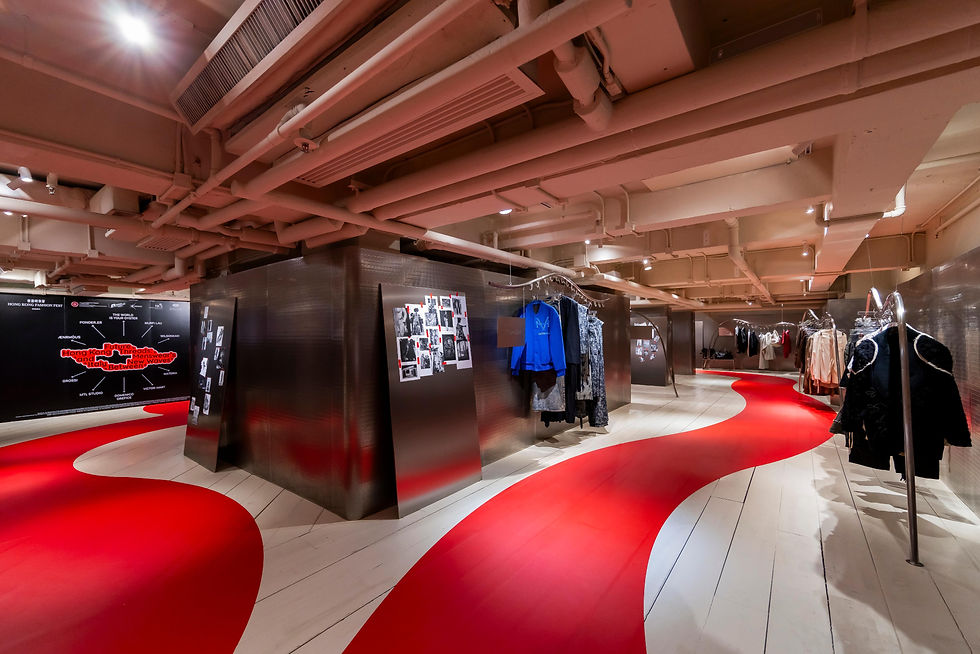
One of the clearest examples appeared away from the main trade fair. At Fashion Walk in Causeway Bay, Future Threads: Menswear's New Waves Between Italy and Hong Kong brought five emerging Italian menswear designers together with five Hong Kong counterparts. The exhibition marked the first strategic collaboration between Hong Kong Design Centre and Camera Nazionale della Moda Italiana, the organisation behind Milan Fashion Week, and was curated by Sara Sozzani Maino.
The participating names included Italian designers Domenico Orefice, Andrea Grossi, Francesco Saverio Matera of MATERIA, Matteo Lamandini of MTL STUDIO and Victor Reginald Bob Abbey Hart of VICTOR HART, alongside Hong Kong labels ÆNRMÒUS, MURFI LAU, PONDER.ER, THE WORLD IS YOUR OYSTER and WILSONKAKI.
The partnership carried a symbolism larger than the exhibition. Milan represents one of fashion's established centres of authority. Hong Kong is attempting to strengthen its own. Putting emerging designers from the two places into direct conversation avoided framing Hong Kong simply as a market receiving European fashion. It allowed exchange to move in both directions.
That idea appeared repeatedly across the 2026 festival. Hong Kong as connector.
Fashion Outside the Fashion Crowd

Perhaps one of the smartest decisions of the 2026 edition was also one of the simplest: much of it was accessible. Wear's HK, introduced for the first time that year, placed 20 established and emerging Hong Kong designer brands across six retail locations from 1 to 14 September. The concept was explicitly built around moving clothing from runway visibility into physical interaction and purchase.
Public exhibitions across Hong Kong Fashion Fest were free. CENTRESTAGE itself opened to the public without charge, and HKTDC reported more than 20,000 public attendances across CENTRESTAGE and the concurrently held Salon de Time.
That changes the atmosphere of a fashion event. The international fashion calendar has traditionally depended upon exclusion. Invitations confer status. Seating charts construct hierarchies. Access becomes part of fashion's mythology.
There is value in industry focused environments, particularly when designers need serious conversations with buyers, press and partners. But Hong Kong's combination of invitation only moments, trade activity and open public programming allowed fashion to operate at several levels simultaneously.
A couture show could remain intimate. A buyer could conduct business at CENTRESTAGE. A student could encounter new designers at an exhibition. Someone walking through the city could discover Hong Kong fashion through a pop up. A fashion culture requires all of them.
More Than Runways

The festival's intellectual programme broadened the conversation again. Fashion Asia's Fashion Challenges Forum brought together figures working across luxury, retail, media, talent and fashion institutions. The 2026 speaker roster included Sara Sozzani Maino, Longchamp Asia Pacific general manager Samy Redjeb, fashion sourcer Gab Waller and others, while Fashion Asia's wider programme combined exhibitions, networking and digital discussions around the realities of building fashion careers and businesses.
The Fashion Summit 2026 added sustainability to the programme, while the 5th Hong Kong Denim Festival examined another part of the city's textile and manufacturing story. The Hong Kong Fashion Fest Gala brought international guests and the 10 Asian Designers to Watch into a more social environment of exchange. Together with VIRTUOSE, CENTRESTAGE, Future Threads and Wear's HK, these formed the eight official flagship programmes of the 2026 edition.
There is something instructive in that structure. Hong Kong Fashion Fest did not behave exactly like a fashion week because it was not one. It had runway shows, certainly, but the runway was only one instrument. Exhibitions lasted beyond individual presentations. Trade happened alongside culture. Retail was integrated. Conversations about sustainability and industry sat beside couture. Museums, shopping centres, convention halls and other spaces became temporary components of the same fashion map.
For a city seeking greater international fashion relevance, that may be more useful than copying a schedule perfected somewhere else.
The City Between Worlds

Hong Kong has long described itself through its position between places. East and West is the institutional phrase, and it appeared repeatedly throughout official descriptions of the festival. There is historical logic behind it, but contemporary Hong Kong is more complicated than a bridge between two fixed cultural poles.
Its fashion opportunity may be similarly more interesting. Hong Kong sits beside mainland China's enormous fashion economy while retaining its own creative history and international commercial infrastructure. Japan and South Korea are close enough to exert cultural and consumer influence. Southeast Asia's fashion industries are becoming increasingly visible. European houses have operated in the city for decades. International retailers, luxury groups, buyers and media understand Hong Kong as a commercial market even when its independent designers receive less global attention.
The 2026 festival suggested that these relationships could be turned into an advantage. Hong Kong does not need a singular fashion aesthetic to become relevant. Its strength may lie in convening different ones. A Vietnamese couturier could show inside the Palace Museum. A Hong Kong visual artist shaped by Scandinavia could return home for a solo runway. Italian and Hong Kong menswear could occupy the same exhibition. Korean brands could arrive as a major international contingent. Designers from across Asia could be evaluated by a jury spanning Shanghai, Seoul, Europe, Hong Kong and international retail. The city became the meeting point.
What Hong Kong Fashion Fest 2026 Actually Proved

There are limitations to any government backed ambition to create a fashion capital. Fashion authority cannot simply be announced. It accumulates through designers who matter, businesses that survive, editors who pay attention, buyers who return, schools that develop talent, consumers who participate and institutions willing to invest over decades.
Hong Kong Fashion Fest is only three editions old. That is precisely why 2026 felt significant. The festival was not evidence that Hong Kong had completed its transformation into one of fashion's essential global capitals. It was evidence that the infrastructure for a more consequential fashion city was being deliberately assembled.
The decision to combine Fashion Fest with CENTRESTAGE was particularly important. Fashion needs romance, but designers also need orders. It needs cultural legitimacy, but it also needs customers. It needs extraordinary images, but it needs manufacturing knowledge, retail, education, capital and international relationships behind those images. The HKSAR Government itself described the 2026 alignment as a way of linking showcases with business opportunity, while CENTRESTAGE's record attendance provided an early indication that the commercial side was capable of attracting significant international participation.
And then there was the city itself. Over those September days, fashion rarely felt confined to a single building. It moved from the museum architecture of West Kowloon to the immense trade halls beside Victoria Harbour, into Causeway Bay, up to The Peak and through retail spaces across Hong Kong. Designers met other designers. Editors discovered names they had never covered. Buyers moved between racks. Couture was examined close enough to see the handwork. Conversations continued over dinners, inside galleries and long after scheduled programmes had ended.
That is harder to quantify than attendance. It may also be more important. Because the most compelling fashion cities create the sense that discovery is possible. They make you curious about who you have not met yet, what you have not seen and where fashion might be moving beyond the handful of names already occupying most of its attention.
Hong Kong Fashion Fest 2026 had that feeling. For Lisière, there could hardly be a more appropriate place to begin.


Comments