
Fashion isn't giving Pierpaolo Piccioli time to build Balenciaga
The collection offered a clearer understanding of his ambitions for the house, even as fashion's impatience with creative directors raises questions about how quickly designers are expected to establish a legacy

Fashion has developed an extraordinary impatience with its creative directors. A designer is appointed, a debut collection arrives, and almost immediately the industry begins debating whether the appointment has succeeded. Every show must deliver a definitive vision, every silhouette must signal transformation, and every season becomes a referendum on whether the person in charge deserves to remain there. Apparently, building a fashion house's identity is now expected to happen at roughly the speed of producing a social media campaign.
Pierpaolo Piccioli has found himself navigating precisely that atmosphere at Balenciaga. Appointed in 2025 following Demna's departure, he inherited a house with two exceptionally powerful creative histories. There is Cristóbal Balenciaga, whose revolutionary approach to construction and volume helped redefine twentieth-century couture. Then there is Demna, who transformed Balenciaga into a contemporary cultural force through experimental silhouettes, streetwear, irony and an extraordinary understanding of how fashion attracts attention.
Piccioli was never going to reconcile those identities in a single collection. His Spring/Summer 2027 presentation in Paris offered something more useful than an immediate reinvention: a clearer indication of the creative methodology he wants to establish.
Couture belongs in everyday clothes
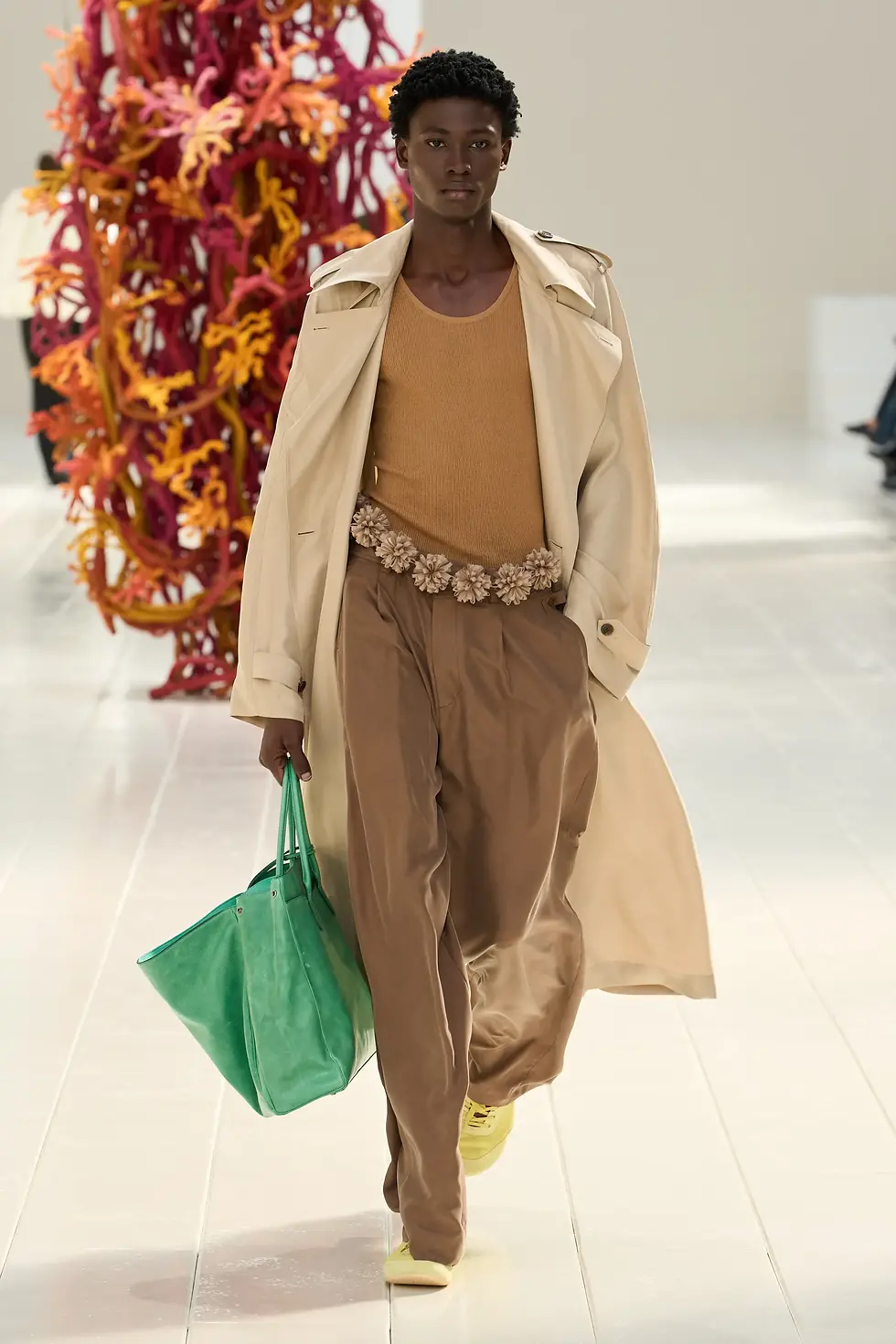
The collection, titled Les Coraux de la Liberté, explored couture not as a separate category of exceptional garments, but as a way of making clothes. Techniques developed within the atelier were applied to familiar wardrobe pieces, bringing precision and structural complexity into shirts, jeans, T-shirts, leather jackets and tailoring.
A white shirt opened the show, its waist shaped through intricate construction and its hem recalling Cristóbal Balenciaga's sculptural silhouettes. Worn with white jeans, the pairing immediately established the collection's central argument. The sophistication was in the making rather than the formality of the outfit.
Elsewhere, stitching techniques associated with couture construction appeared on everyday garments. Bias cutting introduced unexpected movement into denim and tailoring, while functional drawstrings allowed sculptural volumes to be adjusted. These were not couture dresses casually styled with sneakers to make them appear contemporary. They were ordinary garments reconsidered through the technical intelligence of couture.
There were more theatrical moments, including sculptural dresses, elaborate fringe and vivid color. A pale pink garment with the volume of a ballgown was essentially an enormous T-shirt worn over jeans. It was an amusing reversal of the usual relationship between casual clothing and eveningwear, but it also demonstrated Piccioli's underlying logic: construction and proportion could transform familiar garments without removing them from contemporary life.

Not every experiment was equally persuasive. Some pieces relied heavily on recognizable house codes, while the collection's quieter approach lacked the immediate cultural provocation associated with Demna. But judging it primarily by that absence would miss what Piccioli appears to be attempting. He is not trying to out-Demna Demna. He is exploring whether Balenciaga's technical heritage can provide a different foundation for its future.
The problem with demanding an instant identity
The pressure surrounding Piccioli is particularly revealing because speculation about his future at Balenciaga has already circulated despite his relatively short tenure. Such reports remain speculation, but their appearance illustrates how quickly uncertainty can become part of the narrative surrounding a new creative director.
Fashion houses increasingly present appointments as transformative events, encouraging audiences to expect an immediate aesthetic revolution. Designers are hired for their distinctive identities, yet must simultaneously respect heritage, retain existing customers, attract new ones, deliver commercially successful products and establish an entirely new visual language. The expectations are enormous, while the time available to meet them appears to be shrinking.

Piccioli must negotiate Cristóbal Balenciaga's formidable technical inheritance alongside the contemporary identity Demna established over nearly a decade. He must acknowledge both while introducing something sufficiently personal to justify his appointment. That requires more than a convincing runway show. It requires the gradual development of a design vocabulary, collaboration with an atelier, customer response and the accumulation of collections that make sense together.
Spring/Summer 2027 provides evidence of that process. Where Demna frequently used familiar clothing to challenge ideas about luxury, status and taste, Piccioli appears more interested in how construction can transform those garments from within. Both approaches can produce experimental fashion, but they begin with different questions. Whether Piccioli can turn this methodology into a distinctive and commercially successful Balenciaga remains unresolved. There is room for greater surprise, for his relationship between couture and ready-to-wear to develop further, and for his own personality to emerge more forcefully.
Those are legitimate critical questions. They are also questions that cannot be answered responsibly after only a handful of collections.

Fashion needs to rediscover patience
The constant reshuffling of luxury fashion's creative leadership has made novelty an increasingly powerful measure of success. New appointments generate attention, debut collections produce headlines, and the possibility of another change keeps the industry in permanent anticipation. But the qualities that make a fashion house enduring rarely develop at that speed. A recognizable design language requires repetition as well as experimentation. Technical innovation depends on relationships between designers and ateliers. Commercial success cannot be measured solely through runway reactions, particularly when collections take months to reach customers.
None of this means designers should be protected from criticism or granted unlimited time regardless of results. Creative leadership carries significant responsibility, and fashion houses have commercial expectations. But there is a difference between holding a designer accountable and demanding that every season provide a final judgment on their future.

At Balenciaga, Piccioli is attempting something worth watching. He is looking beyond the familiar opposition between heritage couture and contemporary streetwear, exploring how the techniques of one can reshape the garments of the other. Spring/Summer 2027 did not resolve every question about his direction, but it offered a substantive idea worth developing. Perhaps the most revealing thing about the collection is how ordinary its central proposition sounds: take the knowledge of a great couture house and use it to make everyday clothes extraordinary.
Fashion keeps asking designers to reinvent historic houses before they have had time to understand them. Piccioli's Balenciaga is still taking shape. The question is not whether he has already succeeded, but whether fashion is prepared to give him enough time to find out.


Comments