
Fashion Has a Handmade Problem
Luxury has made craftsmanship one of its greatest measures of value. But what does “handmade” actually tell us anymore?

There is a particular kind of fashion image we have learned to trust. A pair of hands pulls thread through leather. An embroiderer bends over a frame. Scissors move slowly around a paper pattern. Someone brushes dye across silk, shapes a flower petal or polishes the edge of a bag. The camera comes close enough to catch the grain of the material and the slight resistance of the needle. There is usually no factory floor in sight. Then comes the word: handmade.
Few words in fashion carry so much implied value while explaining so little. Handmade suggests time, skill, rarity and human touch. It tells us that an object has resisted industrial anonymity and passed instead through the hands of someone who knows how to make it. In luxury, the word can help explain why one bag costs thousands while another with roughly the same functional purpose costs a fraction of that. Among independent designers, it signals intimacy and small-scale production. Across fashion more broadly, it has become shorthand for authenticity itself.
The difficulty is that almost all clothing is made by people. A sewing machine does not independently assemble a dress. Fabric does not feed itself through an overlocker, sleeves do not attach themselves and a finished garment does not emerge untouched from an entirely automated production line. Even within highly industrialised garment manufacturing, human beings cut, position, stitch, inspect, press, trim, correct and pack. If the presence of hands is enough to make something handmade, the distinction between artisanal fashion and ordinary garment manufacturing begins to collapse. Yet fashion continues to use the term as though everyone knows precisely what it means.
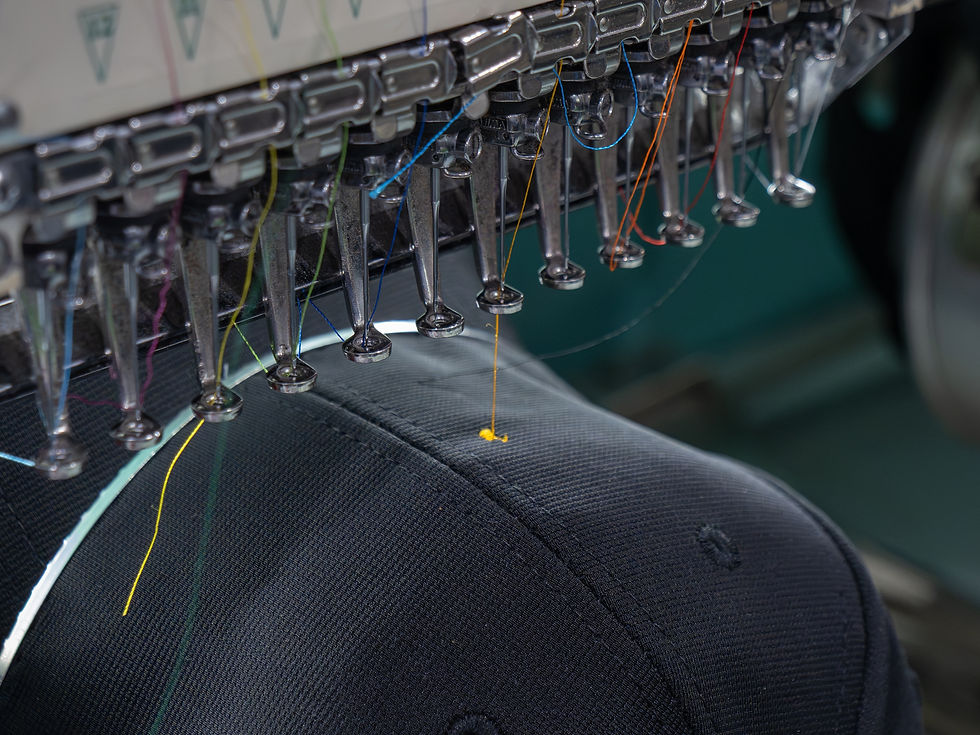
The romantic definition is easy enough to imagine: one craftsperson, one object and no machine between them. Fashion rarely works that way. Some of its most extraordinary examples of craftsmanship combine hand processes with machinery, sometimes within the same technique. An embroiderer may work with a Lunéville hook or guide a specialised embroidery machine manually. Shoemaking passes through numerous tools and processes. Weaving, pleating, leatherwork and embellishment can move continually between hand, tool and machine. Mechanisation does not automatically eliminate craft because, in many cases, knowing how to control the tool is itself part of the craft.

This is where the familiar binary between handmade and machine-made becomes inadequate. The more meaningful question is what the human being contributed that the production system could not simply reproduce without their knowledge. There is an obvious difference between an artisan spending hours building an intricate embroidery and a garment worker repeatedly sewing the same seam within an industrial production system. Both involve human labour, both require competence and both deserve recognition and fair compensation, but they describe very different relationships between maker and object. Skill, judgement, time, transformation and the degree of individual control over the result tell us considerably more than the simple fact that hands were involved.
Luxury understands the emotional power of those hands exceptionally well. As prices have climbed and customers have become more sceptical about what, exactly, they are paying for, craftsmanship has moved increasingly to the foreground of luxury communication. The atelier is no longer hidden behind the finished object. It has become part of the content surrounding it. We see leather being cut, gold being hammered, embroiderers at their frames, feathers manipulated with tweezers and flowers assembled petal by petal. The making of the object becomes part of the object’s value.
There is real importance in making these processes visible. Fashion depends on specialised skills that can take years to acquire and generations to transmit, and some of luxury’s most compelling objects could not exist without them. Specialist ateliers working in embroidery, millinery, feather and flower making, shoemaking, goldsmithing and textile development preserve knowledge that industrial scale alone cannot replace. The extraordinary work produced within these environments is not a marketing invention. It is craftsmanship in its most sophisticated form.
The complication is that craft itself has become one of luxury’s most effective marketing languages. A beautifully filmed artisan finishing one component of a product tells us that the component was beautifully finished. It does not necessarily tell us where the rest of the materials originated, how the object was manufactured before it reached those hands, how many units were produced, who performed the other stages of assembly or under what conditions. A few seconds of extraordinary workmanship can come to represent an entire supply chain that remains largely invisible. The hand becomes a symbol powerful enough to obscure the industrial system surrounding it.
Fashion has already watched another virtuous word undergo this process. Sustainability became so broad, desirable and commercially useful that consumers eventually had to learn an entire vocabulary around greenwashing. Handmade is vulnerable to something similar. When the suggestion of craftsmanship becomes more important than explaining the actual craft involved, the industry moves towards a kind of craft-washing in which atmosphere substitutes for information.
There is another discomfort buried inside fashion’s celebration of the handmade, and it concerns whose hands are granted cultural value. An artisan stitching leather in a European atelier can become part of a luxury house’s mythology. Their bench, their tools and the movements of their hands may appear in campaigns designed to communicate heritage, rarity and exceptional value. A garment worker performing skilled manual operations within a production facility elsewhere in the world is considerably more likely to disappear behind the label.
The distinction cannot simply be dismissed as hypocrisy because genuine differences exist between highly specialised artisanal work and repetitive industrial production. A master embroiderer preserving an intricate technique is not doing the same job as someone sewing the same construction repeatedly on a production line. Yet fashion’s language frequently assigns prestige according to geography and narrative as much as technique. Italian craftsmanship, French savoir-faire, British tailoring and Japanese denim immediately summon worlds of expertise. The skilled hands involved in manufacturing fashion across India, Bangladesh, Vietnam, China and countless other production centres are more often discussed beneath the considerably less romantic heading of supply chain.
One person becomes an artisan while another becomes labour, and the vocabulary matters because value follows it. If fashion tells consumers that human workmanship justifies a premium, the obvious question is how much of that premium reaches the person whose workmanship is being invoked. A product does not become ethically virtuous simply because it was laborious to make. Hand embroidery can be poorly paid. Home-based artisans can remain almost invisible within subcontracting systems. Traditional techniques can become valuable sources of imagery and cultural capital for brands while the communities practising them capture comparatively little of the economic value generated from their work. Handmade describes a process, however loosely. It does not automatically describe a fair one.

This ambiguity has become harder to ignore as luxury confronts a broader question of value. Years of price increases have changed the relationship between what an object costs and what consumers expect to find inside it. The assumption that an expensive object must necessarily contain proportionately exceptional workmanship has become less secure, particularly as customers have gained greater access to information about materials, manufacturing and supply chains. Craftsmanship consequently carries an increasingly heavy burden. It is expected not merely to distinguish luxury, but to help justify its economics.
There is nothing inherently dishonest about luxury pricing extending far beyond the cost of materials and labour. A fashion house charges for design, scarcity, creative direction, distribution, retail environments, communication, heritage and cultural desirability. Fashion has never priced objects according to a calculation of fabric plus hours worked, nor would such a calculation capture everything consumers are purchasing. But once craftsmanship is specifically invoked as evidence of value, asking for greater specificity becomes entirely reasonable.
What, exactly, was done by hand? Where was it done, by whom and for how long? Was the entire object constructed within an atelier, or was one stage hand-finished after industrial production? Is the embroidery manual while the underlying garment is conventionally manufactured? Is the fabric handwoven? Is the leather hand-cut? Was one artisan responsible for the object or did it pass between twenty specialists? None of these models is inherently superior. Collaboration between highly specialised makers may produce something far more sophisticated than the romantic fantasy of a single craftsperson creating an object from beginning to end. The problem is not complexity. The problem is disguising that complexity behind a simpler and more commercially useful word.
Perhaps handmade has simply become too broad to carry the weight fashion places upon it. The industry already possesses a richer vocabulary. Hand-embroidered, handwoven, hand-painted, hand-knitted, hand-dyed, hand-cut, hand-beaded and hand-finished describe actual interventions. Made-to-measure describes something different again. Atelier-made can tell us about the production environment, while naming a particular textile or decorative technique can reveal far more than the generic assurance that an object was crafted.

Specificity does not diminish romance. It makes romance credible. Imagine being told that a dress required seventy hours of hand embroidery, that its textile was woven using a particular traditional process and that its final construction took place in a small atelier where several specialists worked across different stages. That story contains more human value, not less, than simply printing “made by hand” beneath the price. It also restores something conspicuously absent from much of fashion’s craft marketing: the maker.
Even the imperfections commonly associated with handmade production require more scrutiny. We have been taught to interpret an irregular stitch, slight variation or uneven surface as evidence of humanity, as though a flaw proves the authenticity of the hand. Sometimes it does. Yet exceptional craftsmanship can also be astonishingly precise. A master artisan may spend decades learning to make human intervention almost invisible. Perfection is not necessarily evidence of a machine any more than imperfection is proof of craft. The real value lies in accumulated knowledge: understanding how tightly to pull a thread, how silk responds to tension, how leather behaves under particular conditions, how far a material can be manipulated before it fails and how to reproduce a technique taught by someone who learned it from somebody else decades earlier.
That knowledge is difficult to photograph. Hands are easier, so fashion photographs the hands.
This does not mean the industry should abandon the word handmade, nor does the future of craftsmanship require a nostalgic return to a world without machines. That uncomplicated world barely exists outside the fantasy we have constructed around it. Machinery has expanded the possibilities of craft as often as it has threatened them, and many extraordinary artisans work precisely at the point where human knowledge and specialised tools meet. What fashion needs instead is a more exact account of where human skill enters the object and why that contribution matters.
Greater precision would benefit exceptional makers rather than diminish them. A flower shaped petal by petal is remarkable because of what was required to make it. An embroidery consuming dozens or hundreds of hours is remarkable because those hours represent knowledge, concentration and skill. A jacket repeatedly fitted and adjusted until its architecture appears effortless is remarkable. A handwoven textile carrying a technique through generations is remarkable. None of these things needs the fog of an ambiguous claim to acquire value.
The irony is that fashion has spent years persuading us that handmade objects matter because we can feel the human being inside them, while simultaneously making that human being remarkably difficult to see. If craftsmanship is going to remain one of fashion’s most powerful measures of value, the industry should be prepared to tell us more than that hands were somewhere in the process. Tell us what those hands did, whose they were, where they worked and what they knew. Only then does handmade begin to mean something again.


Comments