
DIOR AND MARGIELA JUST ASKED THE SAME QUESTION IN COMPLETELY DIFFERENT WAYS
Two of Paris Fashion Week's biggest shows started with the same old couture distinction: flou versus tailleur.

Fashion weeks are very good at manufacturing trends after the fact. Three designers show red, somebody declares red the colour of the season. Four collections contain lace, suddenly lace is back. But occasionally two collections collide around something much more specific, and the coincidence tells us more about where designers' heads are than another trend report ever could. Yesterday in Paris, it happened at Dior and Maison Margiela.
Jonathan Anderson and Glenn Martens both became preoccupied with the relationship between flou and tailleur, two of the traditional technical territories of couture. Tailleur is the world of structure: jackets, coats, suits and garments constructed through tailoring. Flou deals in softness: dresses, draping, fluid fabrics and clothes designed to move around the body rather than impose a rigid silhouette upon it. Dazed noticed the unusual overlap between two of the day's most significant shows, but what makes it particularly interesting is that Dior and Margiela began with essentially the same technical question and arrived somewhere completely different.

The houses could hardly be better suited to demonstrating the possibilities. Dior's mythology was built partly upon construction, most famously the tightly controlled architecture of Christian Dior's 1947 New Look. Margiela's mythology has long involved pulling the conventions of clothing apart, exposing construction and questioning why garments are expected to behave in particular ways. Put the collections beside one another and a deceptively simple question emerges: what happens when tailoring stops behaving like tailoring?
DIOR LET IT MELT
At Dior, Anderson's answer was softness. The house most associated with the sculpted waist and engineered silhouette has been getting progressively looser under his direction, and Spring 2027 pushed that process directly into the construction of the clothes. Tailored garments borrowed from the techniques and behaviour of flou: jackets softened, houndstooth became sheer, shirts loosened and opened, pajama elements slipped into the wardrobe, and delicate fabrics moved through a collection in which the distinction between tailoring and dressmaking became increasingly difficult to maintain.
Even the Bar jacket, perhaps the most symbolically loaded garment in Dior's archive, appeared less interested in performing its usual authority. Familiar house codes remained visible, but Anderson changed how they behaved on the body. Structure did not necessarily disappear; it relaxed. Rather than treating the archive as a set of silhouettes that must be faithfully reconstructed, he seemed interested in finding out how much he could loosen them before they stopped feeling like Dior.
That approach produced clothes that often felt romantic rather than rebellious. Chiffon, lace, pleating, feathers and translucent surfaces brought sensuality to garments that might traditionally have been defined by considerably greater control. Anderson has spoken about wanting to “rattle the brand and see what falls out,” and here the rattling was less destructive than liberating. Dior still looked like Dior, but some of its clothes appeared to have stopped worrying quite so much about standing correctly.

It fits the broader project Anderson has been developing at the house. Rather than attempting to identify one definitive Dior woman and constructing an entire wardrobe around her, his collections have allowed multiple characters and periods of the archive to coexist. Spring 2027 extended that openness into technique itself. A jacket no longer needs to behave exactly as a jacket historically behaved simply because Dior knows how to construct one impeccably. For a house built upon some of fashion's most recognizable rules, changing the behaviour of those rules can be more interesting than simply abandoning them.
MARGIELA MADE THE CATEGORIES UNSTABLE
Martens arrived at a similar problem and gave a considerably stranger answer. Maison Margiela's Spring 2027 collection also explored hard against soft, taking the traditional divisions of the couture atelier and deliberately forcing them into one another. Dresses could become rigid, tailoring could distort, and materials associated with very different kinds of garment construction occupied the same collection without politely remaining in their assigned categories. Where Anderson used flou to release structure, Martens was interested in the discomfort created when the techniques begin interfering with each other.

This is naturally fertile territory for Margiela. The house has always been fascinated by the moment a familiar garment stops behaving correctly. Construction can be exposed, displaced, exaggerated or deliberately misunderstood, making the viewer conscious of conventions that normally go unnoticed. Martens has inherited that instinct without treating Martin Margiela's archive as the only history he is permitted to reference, which is where this collection becomes considerably more interesting than another exercise in house-code archaeology.
Dazed identified a dialogue with Raf Simons' Spring 2002 collection, another exploration of rigidity and fluidity from a Belgian designer whose influence belongs to a generation of fashion that came after Margiela. That reference matters because creative directors are usually expected to perform a strangely narrow form of historical loyalty. Take over a famous house and its archive becomes the approved family tree, with every reference traced back to the founder as evidence that the new designer has properly understood the assignment. Martens' approach acknowledges something more realistic: designers are shaped by entire fashion cultures, not only by the archives of whichever house happens to employ them.
Margiela therefore uses the flou and tailleur question differently from Dior. Softness does not automatically produce romance, and structure does not necessarily produce control. Martens allows each to contaminate the other, making familiar garment categories less stable in the process. It feels connected to Margiela's history without requiring every idea to originate there, which may ultimately be a healthier way for an established house to have an archive at all.
SAME PROBLEM, DIFFERENT INSTINCTS
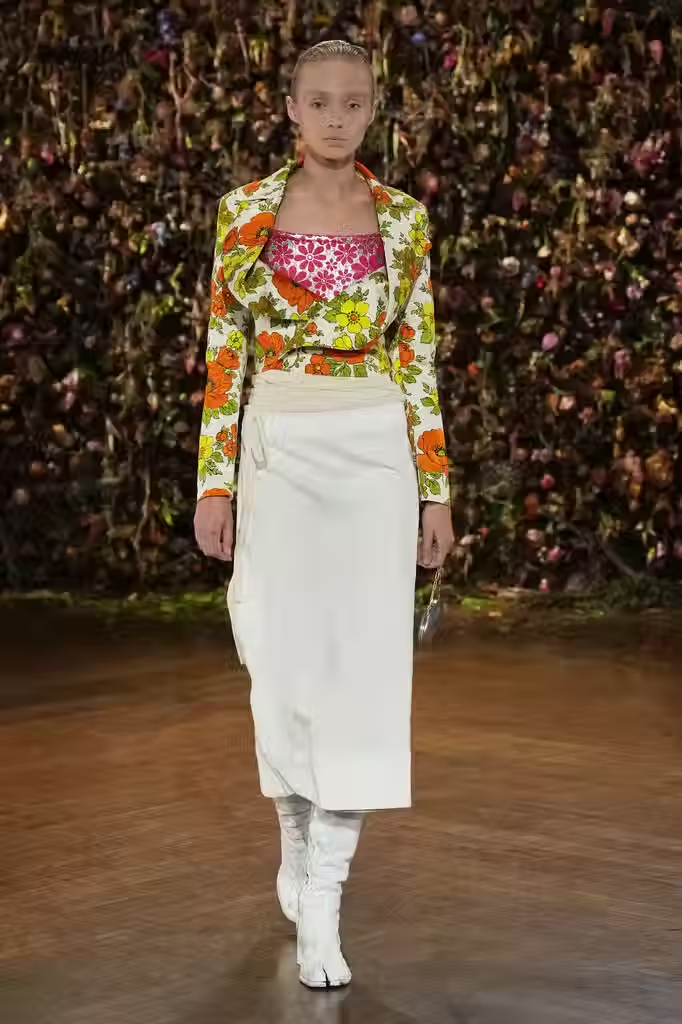
Put the collections beside one another and the contrast becomes unusually clear. At Dior, structure is softened until it becomes sensual. Anderson takes garments historically associated with control and allows them to float, collapse or reveal more of the body beneath them. At Margiela, the encounter is more confrontational. Martens pushes softness and structure together until it becomes difficult to decide which category a garment belongs to in the first place.
The distinction tells us something useful about both designers. Anderson's Dior is increasingly interested in loosening the authority of a monumental house without destroying the beauty that made it monumental. He can disturb the archive while remaining seduced by it, which is why even his more disruptive ideas often resolve themselves into something romantic. Martens operates through a different instinct. Margiela gives him permission to make the familiar slightly wrong, and his strongest work emerges when the viewer recognizes the garment but can no longer rely upon the rules normally used to understand it.
Neither designer invented the tension between flou and tailleur. The distinction is embedded in the history and organisation of couture itself, and generations of designers have crossed its boundaries. What made these two shows interesting was the specificity of the overlap. On the same Paris schedule, two designers at two radically different houses decided that one of couture's oldest technical divisions was worth disturbing, and their responses revealed just how differently the same design problem can be understood.
MAYBE THE GARMENT CATEGORIES ARE THE PROBLEM

There is also a broader reason the question feels timely. Fashion has spent several seasons dismantling the rules that once made wardrobes easy to categorize. Evening clothes appear during the day, underwear becomes outerwear, menswear and womenswear borrow each other's construction, tailoring loosens and dresses acquire structure. Much of that experimentation has happened through styling, but Dior and Margiela pushed the conversation further into the actual making of the garments.
That is where flou and tailleur become more than obscure couture vocabulary. They represent different assumptions about what clothing is supposed to do to a body. One constructs and the other follows; one traditionally imposes a silhouette while the other permits movement. Anderson and Martens both questioned whether those behaviours still need to remain attached to their traditional categories, then used the identities of their respective houses to produce almost opposite answers.
Dior became lighter, softer and more sensual without ceasing to be Dior. Margiela became stranger, harder to classify and deliberately unstable without simply repeating the deconstruction that made the house famous. The coincidence matters because it shows why runway coverage becomes more interesting when collections are allowed to speak to one another. Paris did not give us a new flou versus tailleur trend yesterday. It gave us two designers starting with the same technical problem and demonstrating how completely different fashion can become depending on who is answering it.


Comments