
Can a Runway Show Fix a Fashion Business?
The runway can keep the world looking, but what happens when attention was never the problem?

Dolce & Gabbana can still fill a front row, dominate a red carpet and produce one of Milan's most recognizable spectacles. Behind the glamour, the company is confronting rising debt, operating losses and pressure to strengthen its finances. What can fashion's greatest weapon, attention, actually accomplish when attention isn't the problem?
There was very little about Dolce & Gabbana's Spring/Summer 2027 show that looked like a company under financial pressure. Jennifer Lopez sat in the front row in velvet. Outside, fans gathered for celebrities including K-pop star Choi San. Inside, Domenico Dolce and Stefano Gabbana sent out lace, leopard, embellished denim, crochet, lingerie and enough Sicilian extravagance to make restraint seem like somebody else's problem. Called Stravaganza Siciliana, the collection imagined younger generations rummaging through aristocratic family wardrobes and instinctively mixing decades together. It was lively, excessive and unmistakably Dolce & Gabbana.
The financial statements tell a considerably less glamorous story. Dolce & Gabbana's group revenue fell 2 percent to €1.86 billion in the financial year ending March 31, while the company recorded an operating loss of just over €100 million. Net financial debt increased from €379.6 million to €464.5 million, causing the privately owned group to breach conditions attached to its bank financing. Its lenders subsequently agreed to waive remedies associated with those breaches and suspend financial covenant testing until March 31, 2028. In exchange, Dolce & Gabbana has committed to completing extraordinary financing transactions to strengthen liquidity and bringing its net debt-to-EBITDA ratio below three by that date.

None of this means Dolce & Gabbana is disappearing. The company remains a business generating billions in revenue, and its beauty division has been growing strongly enough to offset some weakness in its core fashion operation. The group has also already raised €150 million by extending its eyewear licensing agreement with EssilorLuxottica until 2050, while potential asset disposals have been among the options considered as it works to strengthen its finances.
But seeing those numbers beside the spectacle of Milan Fashion Week exposes one of fashion's most persistent illusions. Runway shows are extraordinarily good at telling us how healthy a brand feels. They are much less reliable at telling us how healthy the business actually is.
Fashion Week is designed to make us look at the wrong things
The fashion-show system encourages a very particular kind of assessment. Was the collection good? Was the casting exciting? Who sat in the front row? Which look will go viral? Did the designer understand the archive? Which handbag will sell? By the time the final model disappears backstage, an entire verdict on the health of a fashion house can begin forming from approximately fifteen minutes of clothing.
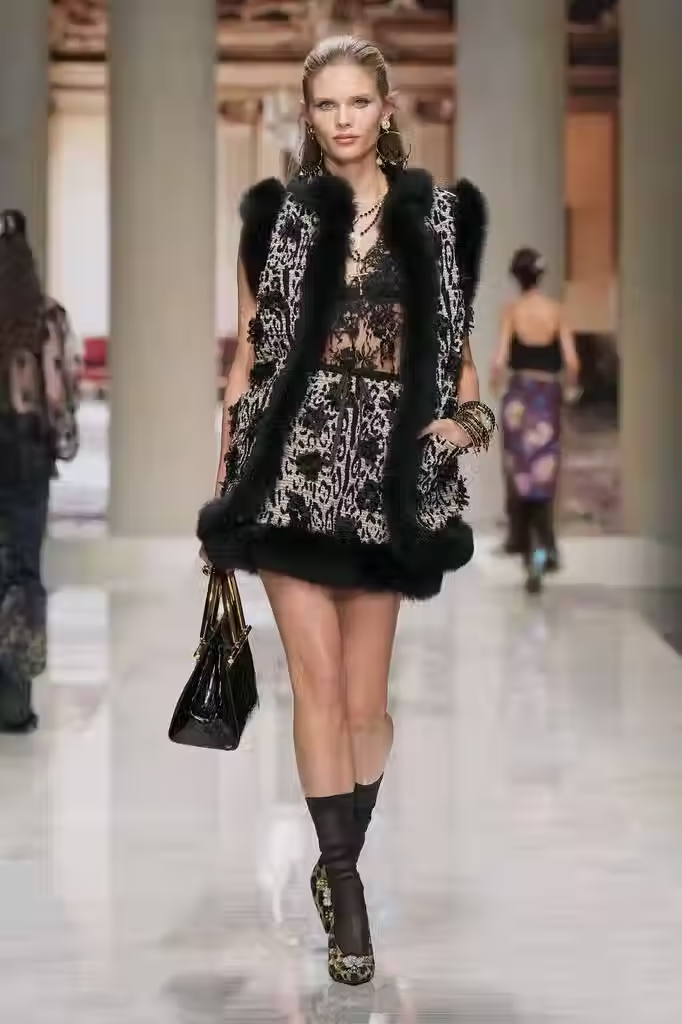
Dolce & Gabbana remains exceptionally skilled at this form of communication. Few houses possess such instantly recognizable codes. Black lace, corsetry, leopard print, Catholic imagery, Sicilian references, lingerie and unabashed sexuality have been repeated, exaggerated and commercially exploited for decades. Even people who do not follow fashion closely can often identify what Dolce & Gabbana is supposed to look like.
Celebrity has amplified that visibility almost continuously. Jennifer Lopez's presence in Milan followed her appearance in Dolce & Gabbana at Vogue World earlier in the week. Madonna remains closely connected to the house. Red carpets routinely supply another stream of high-profile clients and ambassadors. The brand does not suffer from invisibility.
That distinction is crucial because fashion's usual prescription for a struggling brand is remarkably close to its prescription for everything else: generate excitement. Hire a new designer. Stage a spectacular show. Put the right celebrity in the front row. Produce a viral bag. Create a campaign people talk about. Return to the archive. Reinvent the archive. Get everyone looking again. But what happens when everyone is already looking?
Attention and financial health are not the same currency

The current difficulties at Dolce & Gabbana are not reducible to one unsuccessful collection or a loss of cultural recognition. The entire luxury sector has been navigating weaker demand, geopolitical instability and changing consumer behaviour, while Dolce & Gabbana has simultaneously made substantial investments in areas including beauty. Its latest financial statements show that beauty growth helped offset weaker performance in the core fashion business.
That makes the company's position more complicated than the familiar fashion turnaround narrative. This is not simply a forgotten house waiting for the right creative director to make it relevant again. Domenico Dolce and Stefano Gabbana still control the creative identity of the brand they founded in 1985. Their aesthetic remains recognizable. Celebrities still arrive. The runway still produces images. The name still carries enormous global awareness.
The challenge is converting all of that cultural machinery into a financial structure capable of supporting the business around it. A runway can contribute to that. Fashion shows create desire, reinforce brand identity and generate an extraordinary quantity of global media attention in a matter of minutes. For luxury companies selling everything from dresses to handbags, fragrance, cosmetics, eyewear and homeware, the halo created by the runway extends far beyond whatever actually walked down it. The person watching a €10,000 embroidered dress may eventually purchase a bottle of perfume.
But a fashion show cannot renegotiate debt. It cannot repair a balance sheet by applause. It cannot make an expensive retail network efficient or automatically turn social-media engagement into margin. The commercial effects of spectacle are real, but fashion sometimes treats them as magical.

Dolce & Gabbana is selling more than clothes
This is particularly relevant because the modern Dolce & Gabbana business stretches far beyond the runway collection. Beauty has become increasingly important to the group, while eyewear, jewelry, home, hospitality-adjacent projects and elaborate Alta Moda experiences extend the brand into a much larger lifestyle proposition.
That diversification can be an advantage. Beauty gives consumers access to the fantasy at a radically lower price than ready-to-wear, and Dolce & Gabbana's control of its beauty operation has become an increasingly significant part of the business. The eyewear licensing extension demonstrates another way the value of the name can be converted into immediate financial resources.
In that sense, Stravaganza Siciliana does not need to sell every elaborate skirt that appeared on the runway to perform an economic function. It needs to keep the Dolce & Gabbana universe desirable enough that consumers want some part of it.
The question is whether desirability can grow quickly enough to meet the financial demands surrounding the company. That question has become more visible because the corporate structure itself has been changing. Stefano Gabbana stepped down as chairman effective January 1 while remaining co-creative director, and Alfonso Dolce, Domenico Dolce's brother and the company's chief executive, assumed the chairmanship. Gabbana has also reportedly considered options concerning his roughly 40 percent stake in the business.
For a company that has spent four decades fiercely associated with the identities of its two founders, questions of finance, ownership and governance now sit unusually close to questions about fashion.

Independence looks different when money becomes expensive
Dolce & Gabbana's situation is particularly interesting because it remains privately controlled in an industry dominated at the top by conglomerates. Gucci sits inside Kering. Fendi and Dior sit within LVMH. Those structures bring their own pressures, but they also provide access to enormous pools of capital, shared expertise and financial resources that an independent house does not necessarily possess.
Independence has enormous creative and symbolic appeal. Designers can point to freedom from conglomerate control, preserve ownership and make decisions without answering to an external luxury group. But independence also means carrying risk differently when conditions deteriorate.
Dolce & Gabbana has previously left open the possibility of bringing in a minority investor or eventually pursuing a stock-market listing. For now, its agreement with lenders buys time. The banks have suspended covenant testing until March 2028, but the company has obligations in return, including completing extraordinary financing measures and restoring its leverage ratio.
That makes the next eighteen months considerably more important than any single runway review can communicate.
The collection still matters
None of this makes Stravaganza Siciliana irrelevant. In fact, the circumstances make the collection more interesting.

Rather than retreat into safe commercial minimalism, Dolce and Gabbana leaned aggressively into the identity they already own. They mixed tweed with leopard, lace with oversized denim, delicate crochet with exposed lingerie and old-fashioned glamour with deliberately youthful proportions. Domenico Dolce described a world in which a granddaughter raids the family wardrobe and mixes clothes from the 1920s, 1950s and 1970s without worrying about whether they belong together. Vogue noted that the collection felt unusually youthful and lively for the house.
That instinct makes sense. If Dolce & Gabbana needs consumers to desire Dolce & Gabbana, becoming less recognizable would be a strange place to begin. The collection therefore functions less like a creative rescue mission than an argument for the continued value of the brand itself. Look at how much history is here. Look at how recognizable these codes remain. Look at how easily they can be remixed for another generation. Look at the celebrities who still want to participate.
Fashion Week is very good at making that argument. The banks are asking a different question.
A full front row cannot answer everything

There is a tendency to interpret every successful fashion show as evidence of a successful fashion house. The two are related, but they are not interchangeable. A runway can restore cultural relevance. It can launch a product, introduce a designer, generate billions of impressions and remind customers why a brand once mattered. Sometimes that really does begin a commercial turnaround. Fashion businesses sell desire, and desire has to be manufactured somewhere.
But Dolce & Gabbana demonstrates the limits of spectacle particularly clearly because spectacle is one thing the company has never struggled to produce. The house can still create a convincing Sicily. It can still summon Jennifer Lopez. It can still cover a pair of jeans in crystals, send leopard chiffon down a runway and make an audience remember exactly what Dolce & Gabbana means.
What happens after everyone goes home is the harder part. A runway show can remind the world why it wants a fashion brand. It cannot, by itself, make the numbers want it back.


Comments